Tethers Unlimited is a U.S. private aerospace company with its headquarters in Bothell, Washington. They carry out research and development of new products and technologies for space, sea, and air. TU was founded in 1994 to research and develop space tether technology. Applications of space tethers include removal of orbital debris and momentum exchange tethers for moving payloads to higher orbits. Space tethers enjoyed a brief popularity in the space industry community, but interest has fallen off since the 1990s.
In order to survive, TU branched out into other space technologies including power propulsion, actuation and communications for small satellites, robotic technologies for orbital fabrication and assembly, optical fiber winding and deployment, software defined radio communication and 3D printed radiation shielding.
In December of 2018, TU delivered a 3D printer to the International Space Station for testing. Firmamentum, a division of TU, is currently working on its “Spiderfab” technology to “enable on-orbit fabrication of large spacecraft components such as antennas, solar panels, trusses, and other multifunctional structures.”
TU has developed the SWIFT-SLX software defined radio system. U. S. satellites must be assigned frequencies by a federal agency before launch. The conventional approach has been to insert a frequency specific crystal in the radio once the frequency has been assigned. A big problem with this approach has been that the frequency assignment process runs parallel to the construction of the satellite and sometimes, the frequency is not assigned until the last moment. This means that the engineers have to open up the satellite and insert the frequency chip just before launch which is risky.
The SWIFT-SLX takes a different approach. The operating frequency of the radio is determined by onboard software. This means the frequency can be easily set any time before the satellite is launched. It can also be changed after launch while the satellite is in orbit.
The SWIFT-SLX is designed to fit within a cubesat satellite. Cubesats are based on a unit cube four inches on a side and are launched as secondary payloads with big satellites. The SWIFT-SLX can be configured for a variety of mission needs. It can adjust operating frequencies in the S and L band communication channels while in orbit. The development of the SWIFT-SLX was aided by Small Business Innovation Research grants from the Air Force Research Laboratory and the Army Space and Missile Defense Center.
TU has just announced a successful test of two-way radio communication between the Earth and an orbiting satellite carried out by the TU SWIFT-SLX radio. The test allowed communication between Harris Corporation’s first small satellite, the HSAT-1, and satellite ground control. The HSAT was launched last November by India’s Polar Satellite Launch Vehicle.
Rob Hoyt is the CEO of TU. He said, “Our team has worked very hard to bring the SWIFT radios to the level of maturity and quality necessary to meet the needs of top-tier customers such as Harris Corp. The great performance of the SWIFT-SLX right out of the gate is a big testament to our SWIFT team’s efforts and the collaborative support of the Harris integration team.”
-

Tethers Unlimited Has Just Announced A Successful Test Of Its SWIFT-SX Software Radio
-

Trump Administration Is Pressing NASA And NASA Is Pressing Boeing For 2020 Moon Mission – Part 2 of 2 Parts
Part 2 of 2 Parts
Boeing has been criticized for years for the way it was handling the SLS project. Last year, the NASA inspector general delivered a harsh report criticizing Boeing. The report stated that Boeing had already spent five billion three hundred million dollars and is expected to spend the rest of the allocated money by the end of this year three years before the program was supposed to be completed. So far the project has been delayed for two and a half years and four billion dollars of cost overruns have been racked up. The report also said that Boeing had consistently underestimated the scope of the work that had to be done.
John Shannon is Boeing’s SLS program manager. He has admitted that there have been a lot of problems in the program but claims that progress is being made. He said, “We’re late and I completely own that, but we are dialed in now and the team is producing extremely well. I have high confidence that we’re going to come out with an amazing capability by the end of the year, and I can’t wait to get to that point.”
In 2017, the NASA agency watchdog said that NASA had spent a total of fifteen billion dollars so far on the SLS launch vehicle, the Orion crew capsule and the necessary ground systems between 2012 and 2016. It has been estimated that the ultimate cost may reach as high as twenty-three billion dollars. The construction of the SLS and the Orion spacecraft has been parceled out so that every state in the Union now has jobs related to the EM-1 program. All in all, the SLS program supports around twenty-five thousand jobs nationwide. It has had a total economic impact of four billion seven hundred million dollars.
The widespread impact of the SLS program has resulted in strong support in Congress. Some critics have referred to the SLS program sarcastically as the “Senate Launch System.” Boeing is the primary contractor but Aerojet Rocketdyne, Northrop Grumman and the United Launch Alliance are also key contractors. Senator Shelby’s home state of Alabama has benefitted more than any other state from the SLS program. Alabama is the home of NASA’s Marshall Space Flight Center in Huntsville. The SLS program has brought Alabama thirteen thousand jobs and two billion four hundred million dollars.
When the NASA administer raised the idea at the hearing that perhaps the SLS program should be tabled, Senator Shelby said, “While I agree that the delay in the SLS launch schedule is unacceptable, I firmly believe that SLS should launch the Orion.” Following this statement by Shelby, Brindstine said that NASA is committed to building and launching the SLS. The next day, Bridnstine tweeted “Good news: The NASA and Boeing teams are working overtime to accelerate the launch schedule of the NASA SLS.
Critics of the SLS point out that it has been in development for so long that its mission has changed several times and it is based on obsolete technology that has been replaced by advances in the private space sector. The commercial launch industry has been growing beyond the big companies that have supported NASA programs with their hardware in the past. Companies like SpaceX and Blue Orion have been building and launching reusable rockets, boosters and engines which have seriously reduced costs. The SpaceX Heavy Launch vehicle costs about a hundred million to launch. For contrast, it is estimated that the launch of the SLS will cost about a billion dollars per launch.
NASA has been considering replacing the SLS with two commercial launch vehicles. One would send the Orion crewed spacecraft into Earth orbit and the other rocket would carry the Orion to orbit the Moon after Orion docked. Brindstine says that this approach would not be optimum but might be necessary to make the 2020 deadline. NASA has been working on speeding up the schedule for the SLS. The ultimate choice for launch vehicle has not yet been made. -
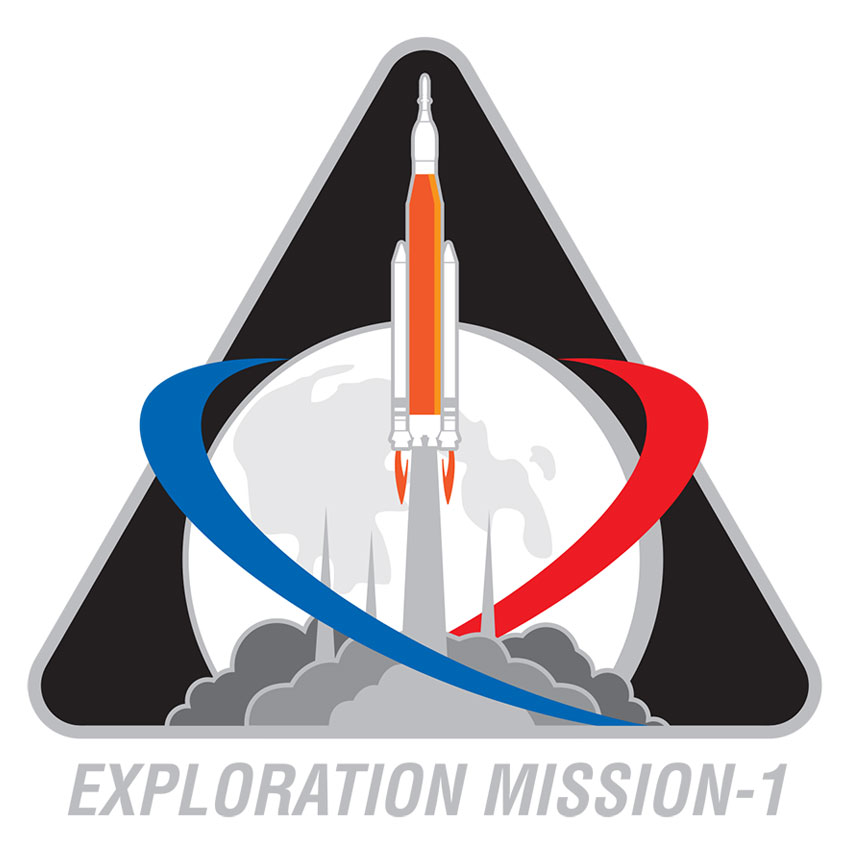
Trump Administration Is Pressing NASA And NASA Is Pressing Boeing For 2020 Moon Mission – Part 1 of 2 Parts
Part 1 of 2 Parts
On big national projects there may be friction between politicians who want to show off a new ship, missile, tank, etc. and the engineers who have to build it and sign off it its completion. Sometimes this has led to embarrassment when the demonstration is not successful because the politicians rushed the engineers. We may be headed for just such a situation here in the United States.
The Trump administration wants to demonstrate advancement in their agenda to return to the Moon to create a permanent settlement. They have been pressing NASA to show some progress before the 2020 presidential election such as sending an unmanned capsule around the Moon and returning it to Earth. NASA, in turn, is pressing contractors like Boeing to get the demo flight ready by 2020 and there are problems.
The launch vehicle that Boeing has been building for NASA is now years behind schedule and billions of dollars over budget. Boeing has notified NASA that there is just no way that the system will be ready for launch by 2020. Currently there is an estimate that the vehicle might be ready to launch by November 2021. Reportedly, NASA was furious when notified that Boeing would miss the 2020 deadline.
There was a hearing on March 13th at the Senate Commerce, Science and Transportation Committee. The NASA administrator Jim Bridenstine said that NASA would consider shelving the massive Space Launch System for lunar missions being built by Boeing and instead they may use commercially available launch services for the Exploration Mission-1 lunar mission in 2020.
Senator Richard C. Shelby is chairman of the appropriation committee and has been the chief Congressional supporter of the Boeing SLS project which has brought a lot of jobs and money to Alabama. Political pressure has kept the dollars flowing to the SLS project in spite of delays and cost overruns. Critics have taken the opportunity provided by the status of the SLS project to attack the rubber stamp attitude of Congress for Boeing and the SLS.
The announcement by the NASA administrator rattled the U.S. space industry. NASA may radically change its approach to launch space missions. The reputation of NASA will suffer because of this major problem with the NASA flagship rocket program and Boeing, its main contractor. It does not help Boeing to have these criticisms surface at the same time as Boeing is being attacked for the crash of two of its 737 airliners. One of the main questions raised at the hearing was whether or not NASA needs to construct and own a heavy-lift rocket. The private space sector already has launch vehicles in operation. They may not have the capacity of the SLS but they are much cheaper to operate and can reuse some components. Some companies are working on rockets that could rival the SLS in launch capacity. The latest budget request from the Trump administration includes mention of a commercial rocket replacing the SLS in a planned mission to send a robotic probe to Europa, a moon of Jupiter that may harbor life.
The Trump budget also requests the use of commercial launch vehicles to place a new space station called the Gateway in an orbit around the Moon. Bridenstine also testified that commercial space vehicles could be used to ferry astronauts to the Gateway station. A planned mission to use the SLS to haul an asteroid into lunar orbit for investigation has been cancelled.
Please read Part 2 -
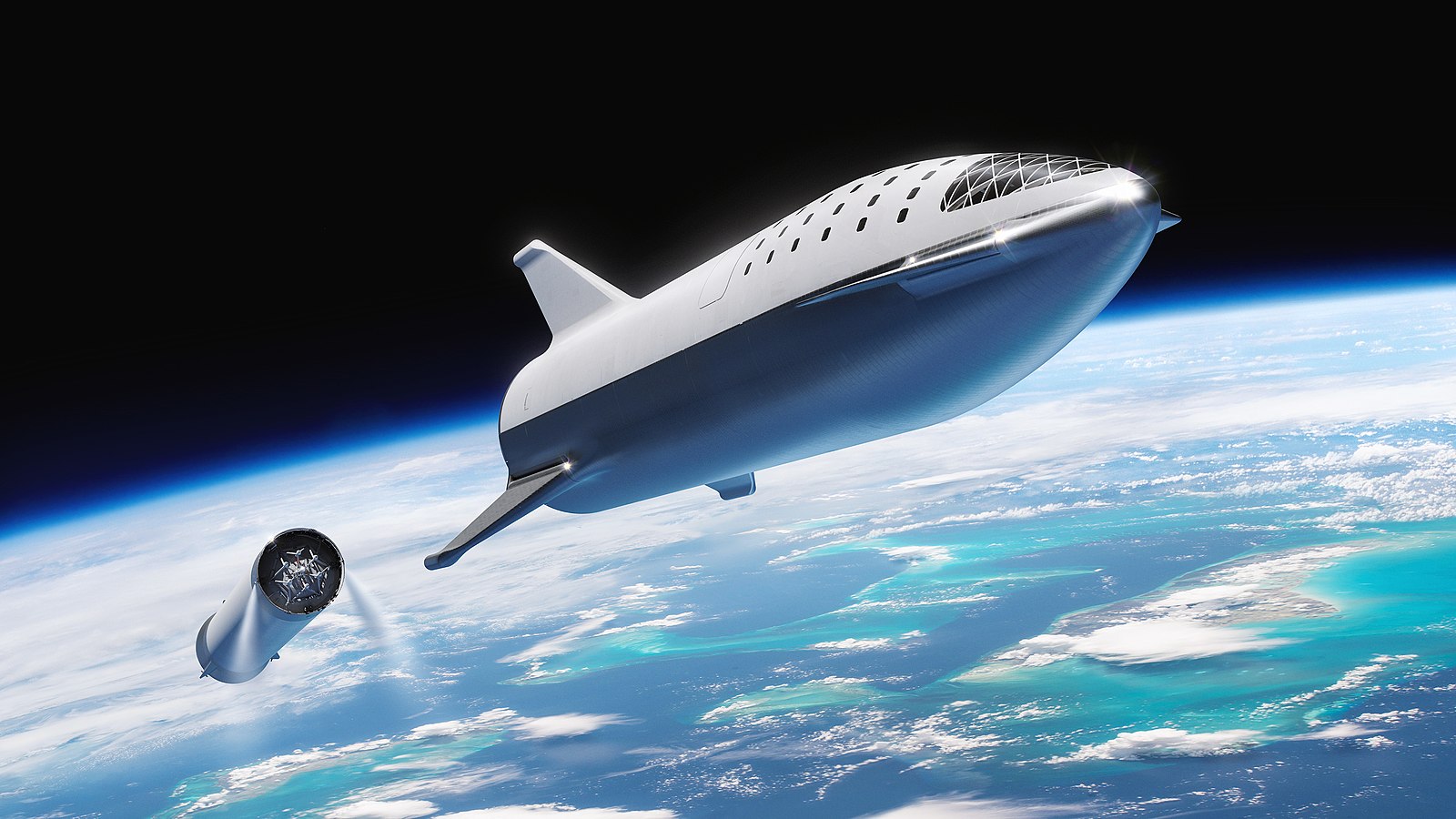
SpaceX Changes Design Of Mars-bound Starship – Part 3 of 3 Parts
Part 3 of 3 Parts
Engelund did say that methane might be a better coolant than water. However, he pointed out that when hydrocarbon fuels such as methane are exposed to very high temperatures, the carbon atoms can stick together and turn into a solid material. This would definitely block the tiny holes used in transpirational cooling. Any impurities in liquid fuels could also clog holes. A possible solution these problems might be to have many more holes than theoretically required.
Once the Starship reached Mars and landed, the find sand and dust on Mars could clog the cooling holes. Engelund said, “Inspection and certification, in general, would be a thing of a concern for a large-scale active system like that — particularly at Mars, where you don’t have access to a big gantry or towers to climb up and inspect. I suppose you could use drones. Maybe that’s something he’s thinking about.”
Musk usually provides full details of his designs for spacecraft, but he has not yet done so for the Starship. He promised that he would provide such details for the Starship following a successful test of a prototype system being built at SpaceX facilities in Texas. It is not clear exactly how much testing SpaceX has actually done on his transpirational-cooling design concept. If the concept does not prove itself in tests, Musk has shown that he is able to adapt innovative designs that have failed in the past. A SpaceX representative said in an email that “We are using the same rapid iteration in design approach that led to the success on the Falcon 1, Falcon 9, Falcon Heavy, and Dragon programs.”
Engelund is skeptical that Musk will be able to successfully construct, launch and land such a big and innovative spacecraft as the Starship. He told an interviewer that “Large-scale entry, descent, and landing is something that NASA has been challenged by for decades. We’ve spent a lot of time and given a lot of thought to how we might do it at Mars. We’ve landed the metric-ton Curiosity rover — that’s the biggest thing we’ve ever put down on the surface of Mars.” He said that the jump from landing a car sized robot on Mars to landing a skyscraper sized spacecraft filled with human beings may not be possible in the near future as Musk envisions. Such a landing is “a couple orders of magnitude” — roughly 100 times — more difficult than the Curiosity landing, which is arguably one of the hardest things we’ve ever done at NASA. It won’t be easy for us or SpaceX.”
SpaceX has challenged any comparison between landing NASA Curiosity rover and their Starship. A SpaceX representative said, “Curiosity was pushing the limits of 1970’s Mars [entry, descent, and landing] technology including a specific parachute-based EDL. We are taking an entirely different approach, leveraging what we have done with Falcon 9, and have ample opportunity to demonstrate it on Earth prior to flying to Mars.”
As creative as the new SpaceX designs for their Starship are, no space technology expert has said that the designs violate any engineering principles. However, as the old saying goes, “In theory. there is no difference between theory and practice, in practice, there is.” -
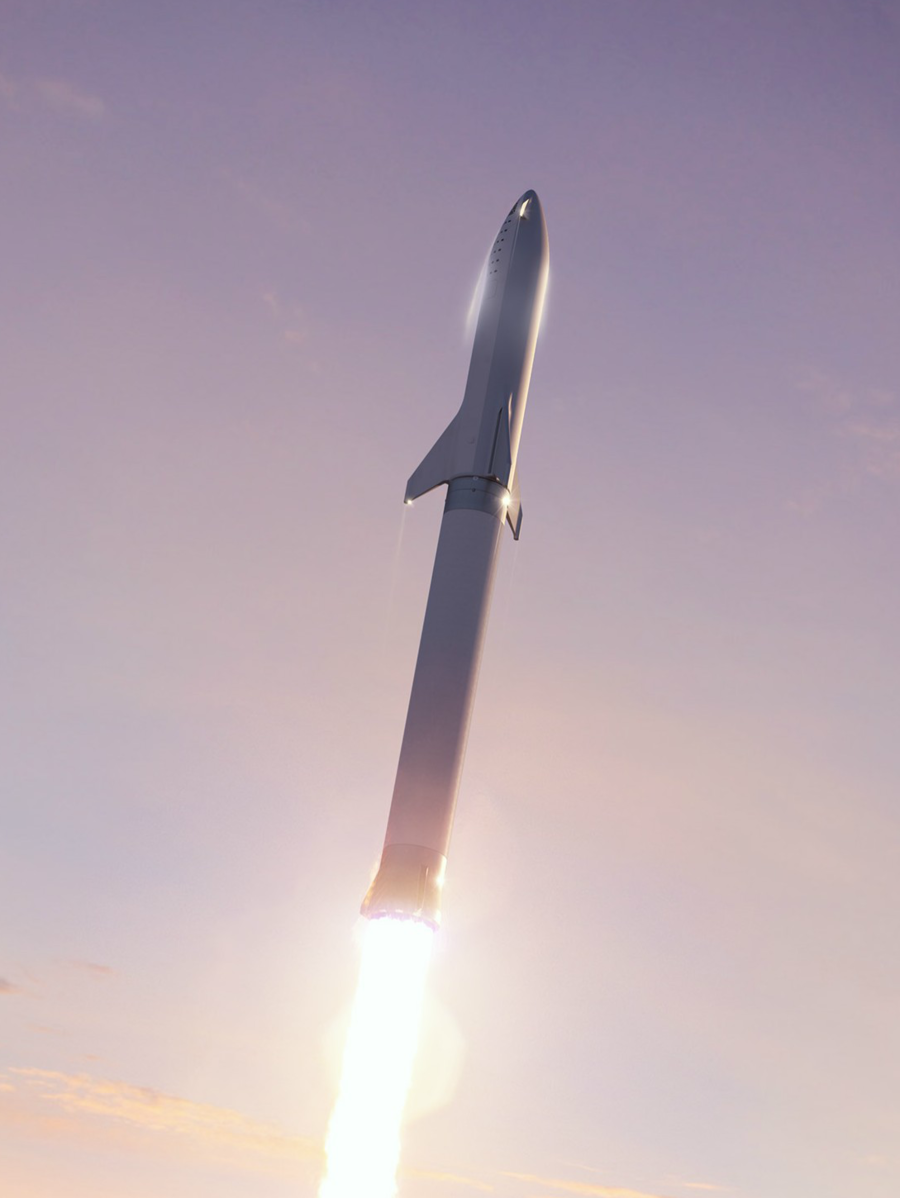
SpaceX Changes Design Of Mars-bound Starship – Part 2 of 3 Parts
Part 2 of 3 Parts
Musk decided to replace the ceramic tiles used in current spacecraft with his new cooling system to reduce the weight of the craft. In addition, if the craft were to lose tiles when it landed on Mars, it would be very difficult to replace them for the return flight to Earth. In place of the tiles, Musk intends to perforate the skin of the Starship with tiny holes which will sweat rocket fuel to carry the heat away from the hull during reentry.
Musk said, “On the windward side, what I want to do is have the first-ever regenerative heat shield. A double-walled stainless shell — like a stainless-steel sandwich. You flow either fuel or water in between the sandwich layer, and then you have micro-perforations on the outside — very tiny perforations — and you essentially bleed water, or you could bleed fuel, through the micro-perforations on the outside. You wouldn’t see them unless you got up close.”
“Transpirational” thermal protection has been around for decades but it has never been used on a spacecraft. In 1965, NASA filed a patent to use the urine of astronauts to cool the bottom of a space capsule to protect it on reentry. During 2006, NASA carried out research on the possibility of using an inflatable, transpiration-cooled heat shield to protect a spacecraft landing on Mars.
In 1976, The U.S. Department of Defense tested a transpiration-cooled nose tip for reentry vehicles containing nuclear warhead. They would fly above the atmosphere and come down on targets thousands of miles away. Most of the research done by the DoD on transpirational cooling is still classified but an engineer who has researched the military use of space technology said that a common problem with such systems was blocked holes that reduced the release of the fluids used for cooling.
Walt Engelund is an aerospace space engineer and the director of the Space Technology and Exploration Directorate at NASA Langley. Engelund said, “You can imagine it wouldn’t take much to clog something like that, if they were microscopic pores.”
Dwayne Day was an investigator for the loss of the Space Shuttle Columbia. He said in an email, “What if a bird poops on your rocket and it plugs up a few holes, and then when the thing is returning, no coolant comes out of those holes and that section of the vehicle overheats?”
Engelund has talked about problems with clogged coolant systems in tests that he carried out at NASA in their hypersonic wind tunnel. Models are tested in the tunnel in winds up to thousands of miles per hour. Some models that used transpirational cooling disintegrated in the tunnel during tests. Engelund said “I’ve seen instances where you’ll get one clogged channel … and it will immediately result in burn-throughs. A model will disappear in a hypersonic wind tunnel. It almost vaporizes, there’s so much energy and so much heat.”
Please read Part 3 -
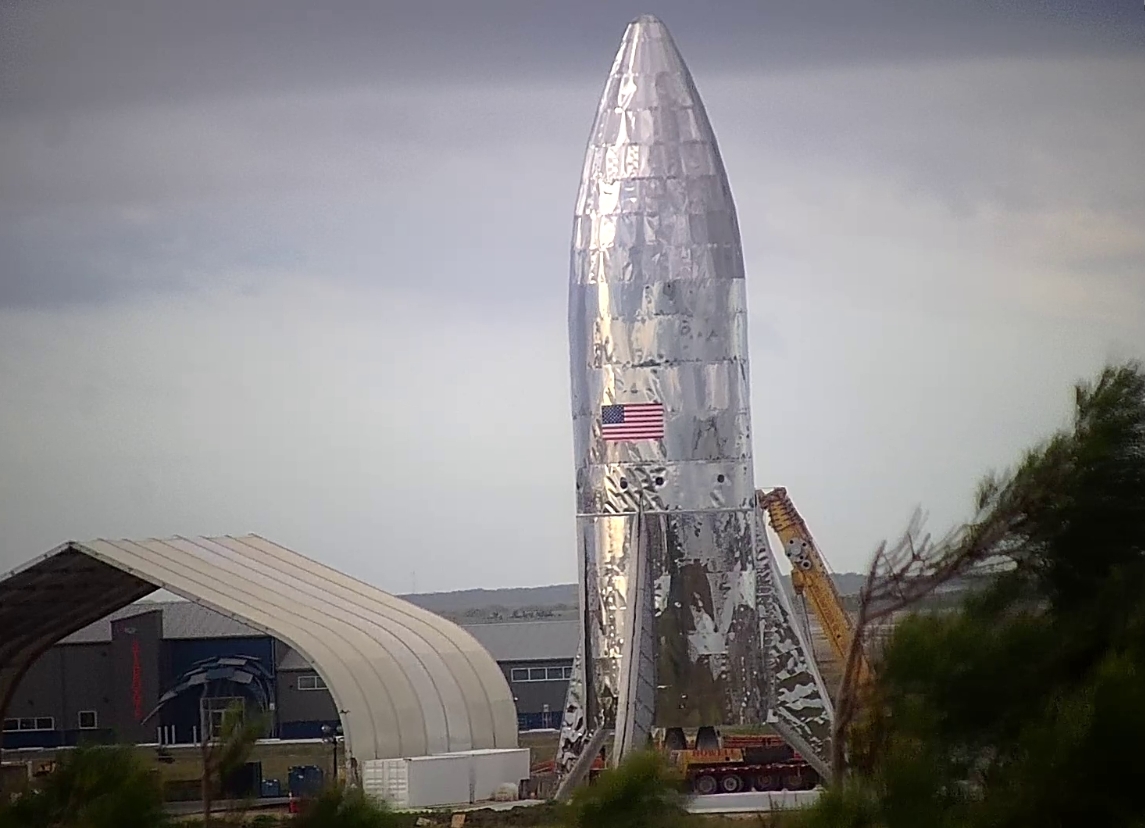
SpaceX Changes Design Of Mars-bound Starship – Part 1 of 3 Parts
Part 1 of 3 Parts
There is a debate going on with respect to which astronomical body should receive the most attention of major space agencies and private space industry. There are arguments for going to the Moon to establish a permanent colony versus sending manned expeditions to Mars. Several different private space companies have set their sights on Mars including SpaceX, the company founded by Elon Musk. He is dedicated to the creation of a permanent human colony on Mars.
SpaceX has been working on the design of a huge reusable spacecraft that he calls “Starship” to take colonists and equipment to Mars. The Starship will be one hundred and eighty feet tall. It will be lifted into orbit by the SpaceX Super Heavy booster that is two hundred and twenty feet tall. The Starship will be refueled in low Earth orbit after launch. It is designed to carry a hundred passengers and a hundred tons of cargo to Mars. Recently SpaceX announced that they had made two radical major design changes to the Starship. Musk called these changes “delightfully counterintuitive”.
Recent SpaceX spacecraft have been constructed from carbon-fiber composites. Musk wants to build Starship from stainless steel alloys. He says that pound for pound, stainless steel is about sixty-seven times cheaper than the light, super-strong carbon-fiber composites that SpaceX had been planning on using to build the Starship. Steel is also much easier to work with than carbon-fiber composites which means that it will be easier and faster to create and test prototypes. It is able to resist intense heat better than carbon-fiber composites. In addition, the strength of steel actually increases by fifty percent when it touches the super-cold methane and oxygen which are used as fuel.
Earlier attempts to use steel for rockets failed because to the weight and strength of steel. Musk claims that he has solved these problems. The Starship will be able to reduce weight because it will not need the heat shielding of current spacecraft and the fact that contact with fuel strengthens steel. He said in a tweet, “I’m confident that a stainless-steel ship will be lighter than advanced aluminum or carbon fiber, because of strength to weight vs temperature & reduced need for heat shielding.”
The other major change has to do with how the Starship will stay cool passing through the atmospheres of Mars and Earth. Currently, landing craft are kept cool during reentry into Earth’s atmosphere by thousands of thick ceramic tiles. This was the system used to protect the U.S. Space Shuttle. The Starship is being designed to “bleed” rocket fuel through tiny holes in the skin of the craft. Theory says that injecting liquid between the stainless-steel skin of the Starship and the super-hot envelope of plasma generated by passage through atmosphere should prevent the destruction of the ship.
The Starship is expected to enter the atmosphere of Earth or Mars at nineteen thousand miles per hour. Parts of the ship could be exposed to temperatures as high as two thousand seven hundred degrees Fahrenheit. Theoretically, that could destroy the steel that will make up the hull of the Starship. The alloy Musk will use is called 310S. It is heat resistant because it contains a lot of chromium and nickel. However, even 310S starts to react to oxygen at around two thousand degrees and melts at about twenty-four hundred degrees.
Please read Part 2 -

SpaceX Starlink Project Launching Thousands Of Satellites To Provide Internet Services
Satellite have been used for communication for decades. Although there have been some attempts to provide Internet services via communication satellites, the technology was slow and expensive which limited its use. These satellites were in geosynchronous orbit which is twenty three thousand miles from the Earth. A signal would need to travel forty-six thousand miles to go from Earth to satellite and back. This means that considerable lag would be introduced.
Several private space industry companies are working on a new approach to providing Internet services to any point on Earth. Instead of a few huge communication satellites far from the Earth, they intend to orbit many small satellites close the Earth to provide full coverage. Last Thursday, the Federal Communications Commission approved applications for four companies to loft hundreds to thousands of satellites to provide Internet connectivity. The four companies are Kepler, Telesat, Leosat and SpaceX.
Ajit Pai is the Chairman of the FCC. He said, “I’m excited to see what these services might promise and what these proposed constellations have to offer. “Our approach to these applications reflects this commission’s fundamental approach to encourage the private sector to invest and to innovate and allow market forces to deliver value to American consumers.”
The FCC are going to allow SpaceX to make use of an expanded ranges of wireless spectrum for his project to deliver universal cheap highspeed Internet access from near Earth orbit. SpaceX plans to ultimately launch up to twelve thousand satellites which will be able to cover the entire Earth. Such universal Internet access would be of great benefit to developing nations and communities in remote locations.
The SpaceX Starlink program will launch its first test satellites this month. The FCC gave SpaceX permission to begin the launch of its first four thousand four hundred and twenty-five Internet satellites next month. An ground station would would send a message to the nearest overhead Starlink Satellite. The signal would then be passed from satellite to satellite around the world via laser. When it reaches the satellite nearest its destination, the signal would be beamed down to another ground station. SpaceX says that it might take up to six years to launchT the total of twelve thousand satellites.
SpaceX has said that it would like to eventually see half of all Internet traffic on Earth go through the Starlink system. However, some analysts believe that the first major clients for the system might be high frequency traders at big banks which would be willing to pay more for such high speed, high volume links.
One of the big concerns with allowing so many new satellites to be launched is the problem of space debris. The U.S. military now tracks over half a million individual pieces of space junk. This includes non-functioning satellites, debris from launch vehicles, debris from manned missions including the International Space Station, debris from collisions between orbiting objects and other sources. The FCC has unveiled a proposal that could introduce new rules to the satellite industry that are intended to reduce orbital debris. Changes may be needed to satellite design and the way that companies deal with outdated satellites. -
Private Israeli Company SpaceIL Getting Ready To Send Beresheet Lander To The Moon
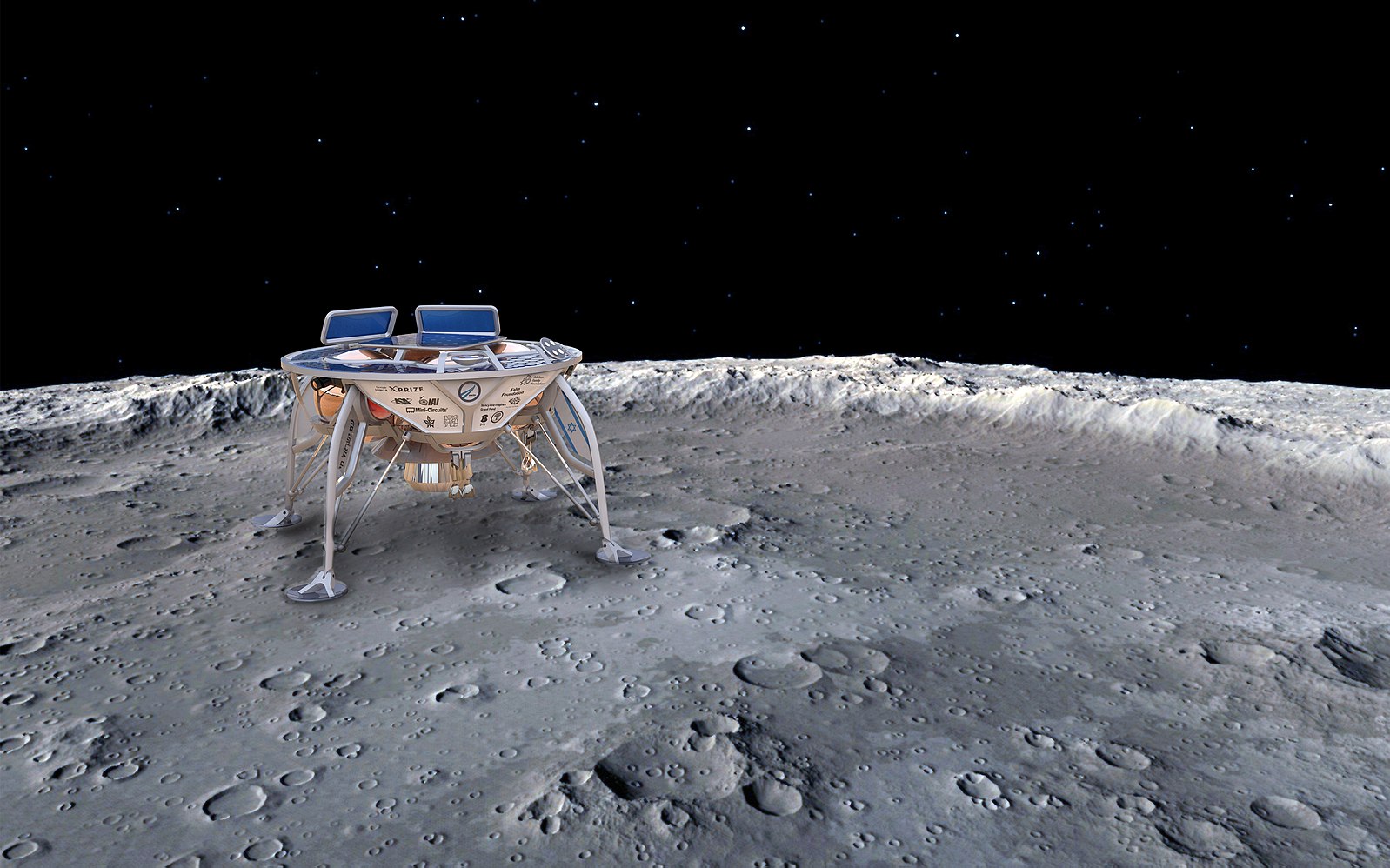
The race to explore the Moon is heating up. Major players such as the U.S. and China are talking about returning to the Moon to stay. A lunar lander was just sent by China to explore the far side of the Moon. In addition to national space agencies, private companies are getting into the game. Now an Israeli nonprofit company named SpaceIL is leading an effort to send a lander to the Moon.
SpaceIL was started in 2011 with the intention of competing for the thirty million dollar Google Lunar XPrize. The GLXP was a contest for privately funded companies. The goal of the contest was to build a spacecraft and send it to the Moon to drop a robot lander to the lunar surface. The rover had to travel at least five hundred meters and send back high-definitions images to Earth in order to win the prize. The GLXP ended in 2018 without a winner.
Despite failing to compete successfully for the GLXP, SpaceIL continued work and its completed lunar lander is now ready to launch from Cape Canaveral, Florida. The plan now is to send the lander to the lunar surface. If lander makes a successful landing, it will then use its rocket engine to take off and land at a second location.
The SpaceIL lander is called the Beresheet. This is a Hebrew word that means “in the Beginning.” The Beresheet is about six feet in diameter and four feet high. It weighs about three hundred and fifty pounds. It also carries almost a thousand pounds of fuel which will be needed to fly from Earth orbit, land on the moon, take off and land at a second location. It carries instrumentation to measure the magnetic field of the Moon. It has a laser-reflector that was supplied by NASA. The Beresheet also carries a time capsule of cultural and historical artifacts from Israel.
The Beresheet lander will be carried into orbit as a secondary payload on a Falcon 9 rocket whose primary payload is a geosynchronous communication satellite. Both payloads will travel about twenty-two thousand miles from the Earth. The communication satellite will go into geosynchronous orbit and the lander will use its own rocket engine to travel the rest of the way to the Moon and land. It will take several weeks to make the journey to the Moon.
The Beresheet lander is not designed for a long mission. Once it gets to the Moon, it may only require a few days accomplish its goals. It is primarily intended to demonstrate some new technology and to highlight a potential business model for sending a spacecraft to another astronomical body.
The Beresheet lander’s legacy will be the technical knowledge acquired by its engineering team, the scientific data returned by its instruments, the business model for operating outside of a national government’s space program and the inspiration for a generation of young people in the Middle East and around the World. -
History Of NASA Work On Lunar Gateway Project – Part 2 of 2 Parts
Part 2 of 2 Parts
In September of 2017, NASA and Roscomos, the Russian counterpart to NASA, signed a joint cooperation agreement. This agreement called for collaboration on exploration of the Moon and deep space, including the development and use of the Gateway.
The U.S. National Space Council was created in 1989 in the Executive Office of the President of the United States during the administration of George H.W. Bush. It was a modified version of the National Aeronautics and Space Council that ran from 1958 to 1973. It was disbanded in 1993.
The purpose of the Council was to advise the president on U.S. space policy. The Secretaries of
State, Treasury, Defense, Communication, and Transportation were included on the Council. The Director of the OMB, the Chief of Staff of the President, the Assistant to the President for National Security Affairs, the Assistant to the President for Science and Technology, the Director of the CIA, and the NASA administrator were also on the Council. The Council was chaired by the Vice President.
The NSC was reformed and reactivated in June of 2017 by the Trump administration. Later in 2017, the Council said that its members felt that lunar exploration should be a primary goal. The Trump administration released its first space policy directive list in December of 2017. In the directive, Trump called for NASA to prioritize a return to the Moon before any manned missions to Mars which had been a priority of the previous Obama administration.
NASA renamed the Deep Space Gateway the Lunar Orbital Platform-Gateway in February 2018 in its budget request for 2019. That budget request also suggested that the U.S. should stop funding operations of the International Space Station in 2024 to free up funds for the Gateway.
At the end of February 2018, NASA held a Deep Space Gateway Science Workshop in Denver. One of the reasons for the workshop was to assist NASA in the development of a science plan for the proposed lunar complex. NASA also launched the Revolutionary Aerospace Systems Concepts-Academic Linkages design competition for university students in 2018. This competition was held to develop concepts for the Gateway.
In the middle of 2018, U.S. Vice President Mike Pence said that U.S. astronauts could possibly travel to the lunar space station as early as 2024. However, so far, the project is in the early design stages. It is a little early to specify completion dates because the design is evolving. The prime contractor for the four-person space station will be announced later this year.
In the same month as Pence made his prediction, Jim Bridenstine, the NASA administrator, told interviewer that the Gateway will not be any where near as expensive as the cost of sending Apollo astronauts to the Moon in the 1960s. As a matter of fact, considering that the NASA share of the federal budget was four and a half percent when the Apollo missions flew and is now only half a percent of the federal budget, the mission could not be accomplished if the costs were comparable to the Apollo missions.
NASA is also encouraging the development of additional international Gateway partnerships. Important candidates for these partnerships will be the current partners of the U.S. on the International Space Station. These partners include Russia, Europe, Japan and Canada. -

History Of NASA Work On Lunar Gateway Project – Part 1 of 2 Parts
Part 1 of 2 Parts
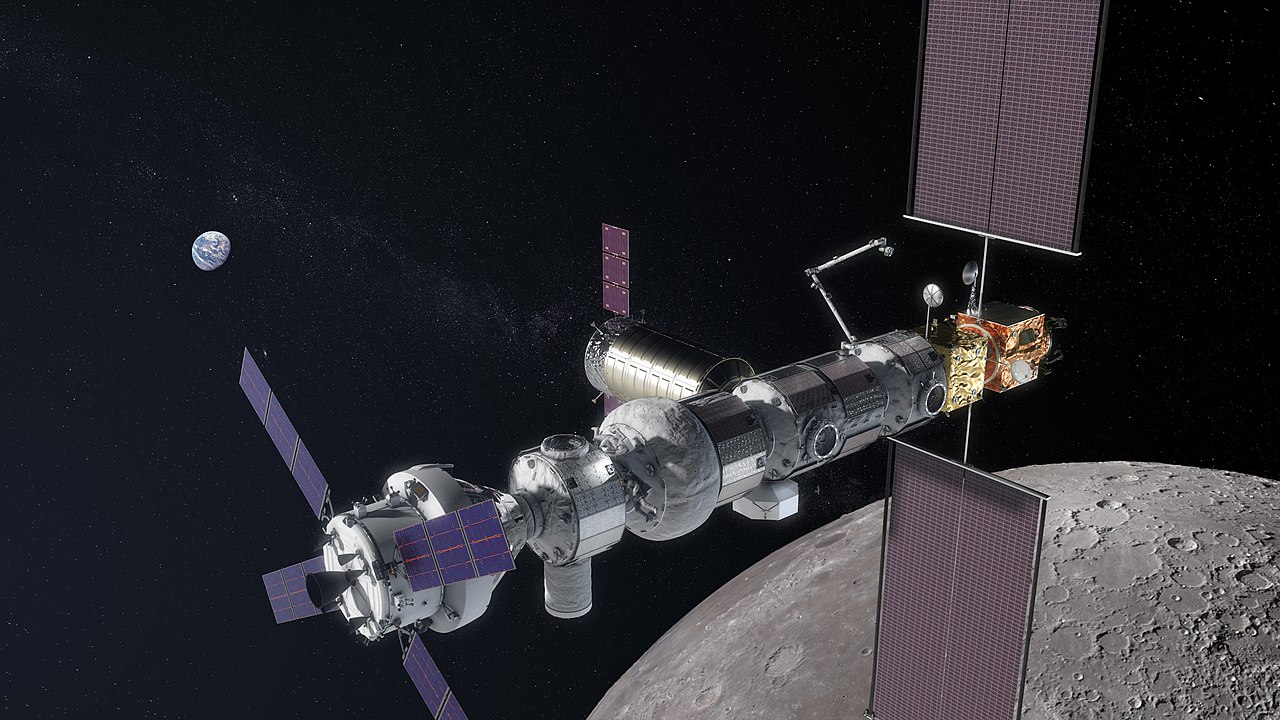
I have blogged before about the NASA Gateway project to build a space station that would share the orbit of the moon and serve as a platform to the support of deep space exploration. Today I will go into more details about the NASA lunar Gateway project.
In 2012, NASA began discussing the concept of an installation on the far side of the Moon which always faces away from the Earth. This installation would be called the Deep Space Habitat. A few years later, NASA started developing ideas for a “cislunar” habitat. Cislunar means that the space station would be somewhere between the Earth and the orbit of the Moon.
In early 2015, NASA awarded a few contracts under its Next Space Technologies for Exploration Partnerships program. The awards were made for the development of ideas for modules that could be attached to the Orion spacecraft and used land on the Moon.
The Orion is a deep space exploration craft under development at NASA. It is designed to carry up to four astronauts and Orion missions could last up to sixty days. Orion is intended to facilitate the exploration of the Moon, Mars and the asteroids. Orion is not expected to fly before 2024.
One of the first times that NASA publicly mentioned a lunar space station referred to as a Deep Space Gateway was in a March 2017 article on a NASA website. In the article, NASA said, “The agency is … looking to build a crew tended spaceport in lunar orbit within the first few missions that would serve as a gateway to deep space and the lunar surface. This deep space gateway would have a power bus, a small habitat to extend crew time, docking capability, an airlock, and [would be] serviced by logistics modules to enable research.”
NASA went on to say that the Gateway would not just support missions in lunar orbit but would also support deep space exploration and exploitation in general. “The area of space near the moon offers a true deep space environment to gain experience for human missions that push farther into the solar system, access the lunar surface for robotic missions but with the ability to return to Earth if needed in days rather than weeks or months.”
In July of 2017, NASA put out a competitive request for information regarding the development of the Power and Propulsion Element for the Gateway. The PPE would supply electrical power as well as chemical and elecrtrical propulsion for the Gateway. By November of 2017, five research contracts related to the Gateway had been signed by NASA. The companies that received the NASA study contracts included Boeing, Lockheed Martin, Orbital ATK, Sierra Nevada Space Systems and Space Systems Loral. The contracts totaled about two and one half million dollars and ran for about four months.
NASA had been studying the design of the PPE module for several months prior to handing out the research contracts. NASA said that these study contracts would allow private space companies to share their ideas for the PPE including the technologies they could offer for the development of the module.
NASA said “We’ve been looking at it internally, but if they have different ideas on the general concept of the gateway, how we can do that and how it aligns with their internal plans, then we’re hoping to get that out of this as well.”
Please read Part 2