Part 1 of 2 Parts
The International Space Station is a habitable artificial satellite in low Earth orbit. The first component for the station was launched in 1998 and the last pressurized module was incorporated in 2011. Components are still being launched to be added to the ISS. The ISS is supposed to be in use until at least 2028.
“The ISS serves as a microgravity and space environment research laboratory in which crew members conduct experiments in biology, human biology, physics, astronomy, meteorology, and other fields.”
The ISS program is a joint project among five participating space agencies: the U.S. National Aeronautics and Space Administration, Russia’s Roscosmos, Japan’s Japan Aerospace Exploration Agency, the European Space Agency and the Canadian Space Agency.
The U.S. Trump Administration budget submitted last February called on NASA to end direct federal funding for the ISS by 2025 in order to free up funds for future NASA projects. At this time, NASA spends between $3 billion and $4 billion each year as its share of ISS operating expenses. Rather than cancel U.S. participating altogether, NASA proposed turning over operation of the ISS to commercial companies. A government auditor has just reported that it is unlikely that any commercial company could afford the huge operating costs of the ISS within the next six years.
NASA’s Inspector General, Paul Martin, appeared before a Senate space subcommittee hearing on May 16th to share his concerns about the planned ISS transition. The hearing was chaired by Senator Ted Cruz and Senator Bill Nelson. Martin said that there is just no “sufficient business case” that could be made for a space industry company to take over the ISS’s annual operating budget which is expected to reach $1.2 billion by 2024. Industries such as space research and development and space tourism have not yet taken off. The private space industry is not very interested in using the ISS for research or profit. Martin said, “Candidly, the scant commercial interest shown in the station over its nearly 20 years of operation gives us pause about the agency’s current plans.”
Martin went on to say that transitioning the ISS to the private sector would probably not save NASA much money. NASA would still continue to launch astronauts and cargo to the ISS and return astronauts and cargo back to Earth. Launching payloads into low Earth orbit is not cheap. In fiscal year 2018, NASA spent $1.7 billion on transportation to and from the ISS. So, ending direct federal funding of the ISS will not free up $3 billion to $4 billion as might be expected.
Martin said that there was an obvious alternative for NASA. The U.S. should extend federal funding beyond 2024 which is the year that the ISS programs budget is scheduled to end. Martin pointed out that many of NASA research goals for the ISS will not be completed by 2024. If funding is extended, then NASA will be able to finish its current research projects. Boeing built most of the ISS and says that the ISS should be able to last until 2028 without the need for major maintenance.
Please read Part 2
Category: Uncategorized
-

U.S. Congress Is Debating Funding For The International Space Station – Part 1 of 2 parts
-

Arch Mission Foundation Intends To Send Millions Of Pages Of Wikipedia Articles To The Moon – Part 2 of 2 Parts
Part 2 of 2 Parts
The AMF has already sent archived text into space. When Elon Musk launched his Tesla Roadster into space, the entire text of Isaac Asimov’s Foundation Trilogy was inscribed on tiny digital storage devices called Archs and placed into the Roadster before launch. This series of novels inspired many readers to choose careers in the social and physical sciences.
Space is a very harsh environment and storing data safely for the long term is difficult. There are bursts of intense radiation that could damage just about any storage media. Temperatures vary over such an extreme range that storage media could be damaged and corrupted. For the Roadster launch, the mineral quartz was chosen as the storage media. The AMF used a laser to burn tiny holes into small quartz disks about the size of a U.S. quarter to create what is called 5D optical storage. Beyond the three spatial dimensions, 5D storage also utilizes the size of the hole and its shape to encode information.
For the Peregrine project, the AMF chose the element nickel for the storage media. Squares of pure nickel that are thinner than a human hair and about the size of a postage stamp will be used. Spivack says, “Nickel is an element that doesn’t corrode, lasts basically forever in space, and cosmic rays won’t hurt it.” Lasers will etch the information into the surfaces of the sheets of nickel. Each sheet can hold up to sixteen thousand pages of text. The text on the sheets can be read with any 1000X optical microscope. As many as fifty million pages of text will be sent on the Peregrine.
The AMF intends to send additional archives to the Moon as time passes. They are also going to create a Mars Library and additional libraries for other locations in the Solar System. They want to distribute such archives as widely as possible to increase the chances that they will survive far into the future. Eventually, the AMF intends to connect Arch Libraries through a “decentralized read-write data sharing network that spans the Solar System.”
The AMF says that there will also be a way for the public to get involved and help choose what is sent. They will allow people to make donations to have specific information included in the Archives. They have also promised that they will not exert any censorship over the information that people want to include. The AMF says that the reason that they are not emphasizing science and technology in their data sets is because they assume that any aliens with sufficiently advanced technology to get to our solar system from a planet around another star would have scientific and technical knowledge far above ours. It is also assumed that they would be most interested in our cultures.
Alien cultures may chose to immortalize their cultures and knowledge by creating something like the Archs from the AMF. One possibility would be to create self-replicating archival spacecraft which would travel to other star systems and create more copies of themselves to spread their information further. It is estimated that such a plan could see every star in the Milky Way visited within ten million years. Perhaps such archives exist in our solar systems just waiting to be discovered. -

Arch Mission Foundation Intends To Send Millions Of Pages Of Wikipedia Articles To The Moon – Part 1 of 2 Parts
Part 1 of 2 Parts
Sometimes societies make a deliberate effort to collect and preserve their cultural knowledge. Once in a while, we find caches of hidden documents such as the Dead Sea scrolls left by a religious community two thousand years ago in caves in the Middle East. There are also “time capsules” left from time to time with samples of cultural artifacts. Then there are the statues, buildings, monuments, and inscriptions left from past civilizations. Now some people are concerned about preserving information from the present age for civilizations yet to come or perhaps visiting aliens.
The Arch Mission Foundation is a non-profit organization founded in 2015 by Nova Spivack and Nick Slavin. Its goal is to “…create multiple redundant repositories of human knowledge around the Solar System, including on Earth.” It also hopes that its effort to establish archives of our present culture in locations off Earth will stimulate interest in space exploration. Its mission statement says that it is going to create, “…multiple Arch libraries intended to preserve and disseminate humanity’s knowledge across time and space for the benefit of future generations”.
Nova Spivack, one of the founders says, “We thought of this project to archive human civilization around the Solar System — to create a permanent off-site backup of all our cultural achievements. So, our knowledge, our art, our languages, our history — all the stuff the human mind has produced. The idea is that these archives could last for millions to billions of years in space, where they might be found and read by future humans.”
Astrobotic Technology is a startup company in the burgeoning space industry founded in 2008 by Carnegie Mellon professor Red Whittaker and his associates. The original purpose of AT was to compete in the Google Lunar X prize contest. AT is developing space robotics for planetary missions. They want to be the first delivery service for the Moon. AT is developing a variety of robots that will be able to land payloads on the Moon. They are also building lunar rovers for delivery and exploration. AT’s first mission will be a lunar lander called the Peregrine. Circumstances permitting, the Peregrine will be taken to the Moon by an Atlas V launch vehicle around 2025.
The Arch Foundation will send millions of tiny sheets of metal inscribed with Wikipedia entries and other information packed into a special cylinder aboard the Peregrine. Millions of the hair-thin sheets will fit in a package about the size of a compact disk.
John Thornton, the CEO of the AMF, said, “It’s humbling to think our mission to the Moon will deliver something that could be read millions of years from now,” John Thornton, AT’s CEO, said in a statement. “Arch’s Lunar Library will be a monument not only to human knowledge and culture, but also the first commercial mission to the Moon.”
Spivac says that their archive will include Wikipedia articles in other languages. The Long Now’s Rosetta Project, which is a digital library of over fifteen hundred different languages will also be included. During the next year, the AMF will announce other information that will be included in the package sent to the Moon.
Please read Part 2 -
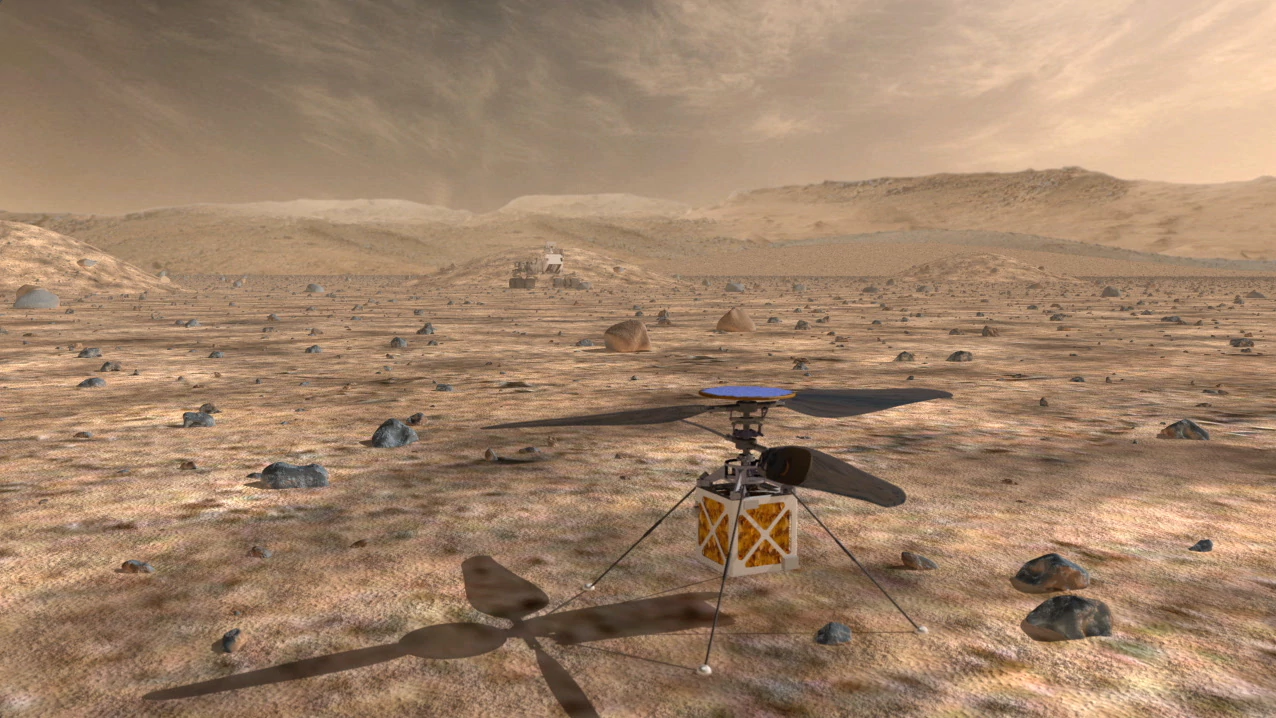
NASA Is Sending A Helicopter To Mars
The exploration of Mars has taken place either in orbit or on the surface. So far, the vehicles that have been sent to Mars and landed on the surface have been wheeled. They have had to navigate across a rough landscape, avoiding many obstacles. Thus, they have been confined to areas which are mostly open and flat.
NASA has announced that a Martian helicopter will be bundled with a Mars Rover that is going to be launched in July of 2020 and land on Mars in February 2021. The purpose of the Helicopter is to demonstrate the feasibility of deploying heavier than air craft to Mars.
The Martian Helicopter project began in August of 2013 at the NASA Jet Propulsion Laboratory. The team spent four years designing and testing the Helicopter.
Associate Administrator for NASA’s Science Mission Directorate said, “Exploring the Red Planet with NASA’s Mars Helicopter exemplifies a successful marriage of science and technology innovation and is a unique opportunity to advance Mars exploration for the future. After the Wright Brothers proved 117 years ago that powered, sustained, and controlled flight was possible here on Earth, another group of American pioneers may prove the same can be done on another world.”
The Martian Helicopter is the size of a softball and weights about four pounds. It has been designed to fly in the atmosphere of Mars which is one one hundredth the density of the Earth’s atmosphere.. The Helicopter has two blades that will spin at about three thousand revolutions per minute which is about ten times faster than the blades of an Earth helicopter spin. The Helicopter contains solar cells to charge lithium ion batteries and a heating mechanism to keep it warm during the Martian nights when the temperature can drop to -225 degrees Fahrenheit.
There will be thirty days dedicated to tests for the Helicopter. The Rover will carry the Helicopter to a good place to take off and, after dropping off the Helicopter, will retreat to a safe distance. For the first flight, the Helicopter will climb to about ten feet and hover for thirty seconds. Five flights will take the Helicopter further and further up to a few hundred meters and durations of up to ninety seconds.
NASA administrator Jim Bridenstine said, “The idea of a helicopter flying the skies of another planet is thrilling. The Mars Helicopter holds much promise for our future science, discovery, and exploration missions to Mars.”
Although the Martian Helicopter is technically a drone because no one is riding in it, it was decided to refer to it as a helicopter. The distance from Earth to Mars varies from about thirty-four million miles to about sixty-three million miles. This is two far away to control the Martian Helicopter remotely, so it will have to use artificial intelligence to guide its own flight.
The project manager at the Jet Propulsion Laboratory said, “The altitude record for a helicopter flying here on Earth is about 40,000 feet. When our helicopter is on the Martian surface, it’s already at the Earth equivalent of 100,000 feet up.”
NASA is referring to the Martian Helicopter mission as “high risk”. In a statement, a NASA spokesperson said, “If it does not work, the Mars 2020 mission will not be impacted. If it does work, helicopters may have a real future as low-flying scouts and aerial vehicles to access locations not reachable by ground travel.” -
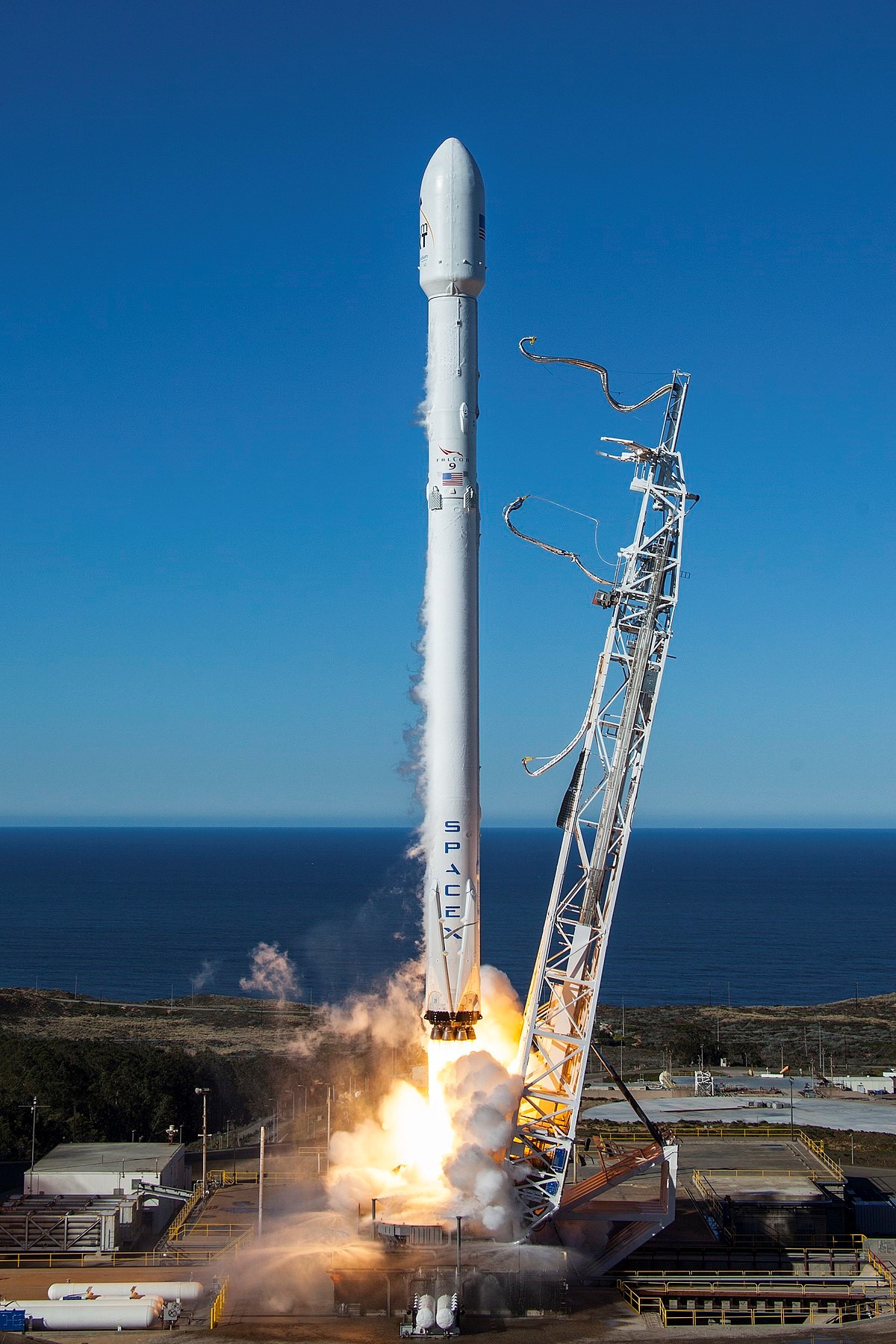
NASA Concerned About SpaceX Plan To Super-Cool Propellant For Falcon 9
Space Exploration Technologies is an private U.S. aerospace manufacturer and space transportation services company. It was founded in 2002 by Elon Musk with the stated mission of reducing space transportation costs and enabling the colonization of Mars. SpaceX has developed the Falcon family of launch vehicles and the Dragon family of spacecraft. They have pioneered the soft landing and reuse of their launch vehicles. Currently, SpaceX is delivering supplies to the International Space Station under a contract with NASA.
When SpaceX was developing ways to make their Falcon 9 rocket more powerful, one of the ideas they came up with was to keep the propellant at super-cold temperatures. This would reduce the volume of the propellent and allow more to be packed into the tanks on the rocket.
Some safety experts have criticized this idea because they say that it carries major risks. In order to untilize such super-cold propellent, it would have to be loaded into the rocket just before launch. If it were a manned flight, the astronauts would already be aboard the rocket. Any accident or spark during fueling could lead to an explosion.
Because of these possibilities, some members of Congress and NASA safety experts have expressed concerns about SpaceX implementing their super-cold propellent concept. NASA and SpaceX are preparing to launch people into orbit on Falcon spacecraft as early as this year. A NASA advisory group said that the new fueling method was “contrary to booster safety criteria that has been in place for over 50 years.”
NASA’s worries about astronaut safety peaked in September of 2016 when a SpaceX Falcon 9 rocket blew up during fueling for an engine test. No on was injured but a very expensive satellite was lost in the explosion. This pointed out the possible danger of having astronauts aboard a spacecraft while it was being fueled.
NASA is not the only member of the space industry to be worried about SpaceX’s fuel loading plans. John Mulholland oversees Boeing’s contract to fly astronaut to the ISS. He once worked on the space shuttle. He said, that the late fuel loading plan which is called “load-and-go” was rejected by NASA because “we never could get comfortable with the safety risks that you would take with that approach. When you’re loading densified propellants, it is not an inherently stable situation.”
Musk is a flamboyant entrepreneur who is willing to take risks in the high-stakes game of space exploration. He has problems with the bureaucratic system in place at NASA. Some people believe that the agency became too paranoid and cautious following the two shuttle disasters in which fourteen astronauts lost their lives. Those who support SpaceX and Musk’s risk taking say that tradition and old ways of thinking are the enemies of innovation and are impeding the exploration of space.
A professor at the University of Southern California who served on the Trump transition team said that “NASA is supposed to be a risk-taking organization. But every time we would mention accepting risk in human spaceflight, the NASA people would say, ‘But, oh, you have to remember the scar tissue’ — and they were talking about the two shuttle disasters. They seemed to have become victims of the past and unwilling to try anything new, because of that scar tissue.”
A former NASA acting administrator said that NASA and the whole society in the U.S. has become too risk adverse. He recently said “I worry, to be perfectly honest, if we would have ever launched Apollo in our environment here today if Buzz [Aldrin] and Neil [Armstrong] would have ever been able to go to the moon in the risk environment we have today.” -
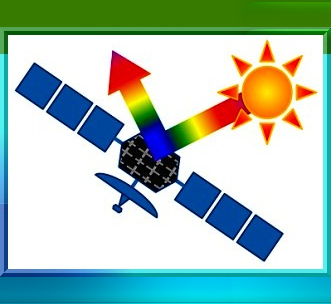
Team At The University Of Southampton Develops New Coating For Spacecraft
One of the big problems for spacecraft in the coldness of space is heat. Whatever parts of the spacecraft are exposed to the direct light of the Sun will begin to heat up. There is also the problem of heat in the spacecraft that needs to be radiated away.
Spacecraft are protected from overheating by metamaterial optical solar reflectors. The meta-OSRs are the outermost layer of the coating on the outside of the spacecraft. They are designed to efficiently radiate away infrared heat generated by the spacecraft while also reflecting most of the optical part of the solar spectrum.
The meta-OSRs are very important to the spacecrafts ability to control heat. They are glued to the external skin of the radiators. The current meta-OSRs are usually quartz tiles that effectively combine thermos-optical properties with the ability to survive in the harsh environment of space. Unfortunately, quartz tiles are both fragile and heavy. They increase assembly and launch costs substantially. They also cannot be added to a curved surface.
Other commercial solutions to deal with heat on spacecraft have been based on polymer foils which quickly degrade. They do not usually last more than five years and are thus unsuitable for long missions.
Now a team from the University of Southampton in the U.K. has developed a new meta-OSR. They employ a metal oxide which is commonly used for transparent electrical contacts. In the new meta-OSRs, the metal oxide is formed into a metamaterial pattern with a strong infrared emissivity and a low absorption of the optical solar spectrum. The team has also developed a “smart” radiator based on their new metamaterial design. This smart radiator permits the radiative cooling of the spacecraft to be tuned. It utilizes a different metal oxide.
Professor Otto Muskens, from the University of Southampton and principal investigator of the study, said: “The meta-OSR technology is entirely based on durable and space-approved inorganic coatings, which can be applied onto flexible thin-film substances with the potential to be developed as a new technology solution. Since the assembly and launch costs of OSRs is several tens of thousands of US dollars per square meter, even small improvements in weight reduction can make a significant change to the space industry.”
The study was part of a two-year Horizon 2020 space technology project. The University of Southampton is a member of the META-REFLECTOR consortium. The Italian Centro Ricerche Elettro-Ottiche, the Danish nanoimprint developer NIL Technology and Thales Alenia Space are also members of the consortium.
The journal ACS Photonics published two reports on the work of the consortium. They are ‘VO2 Thermochromic Metamaterial-Based Smart Optical Solar Reflector’ and ‘Metasurface optical solar reflectors using AZO transparent conducting oxides for radiative cooling of spacecraft’.
Doctor Kai Sun from the University of Southampton said, “All of the partners have actively worked together to ensure the design and fabrication are suitable for its transfer to mass-production. It is an exceptional research experience to transfer the cutting-edge research idea to a commercial product.”
The Southampton team is currently working on expanding the prototypes to larger areas through the use of processes developed by NIL Technology. First space tests of the new meta-OSR are in preparation.
Doctor Sandro Mengali at CREO said: “Passive control of the thermal emissivity is important to preserve precious heat during start-up and eclipses and to maintain the temperature stability of the spacecraft. Currently, thermal emissivity control requires bulky mechanical components such as louvers, which are extremely expensive and prone to failure, posing significant risk to missions. The smart meta-OSR technology will offer a valuable new tool for thermal engineers of spacecraft, of particular importance for the lightweight segment of the satellite market.” -
Sabre Jet-Rocket Engine Is Under Development
Reaction Engines Limited is a company based in Culham in Oxforshire, U.K. They are working on a novel propulsion system that can function as both a jet engine for flight in atmosphere and rocket engine for flights in space. The company hopes that the engine they are developing will transform the space launch market as well as permit hypersonic travel to destinations on Earth.
In the past three years, REL has raised about a hundred and forty million dollars. This includes eighty-four million dollar from the British government, twenty eight million dollars from BAE Systems and thirty six million dollars from BAE Systems, Rolls-Royce, Boeing, Baillie Gifford Asset Management and Woodford Investment Management.
In an interview, the REL CEO said, “Rolls are super-positive about the technology. They want us to be independent and innovative, and to push our technology as hard as possible. And Boeing – that’s amazing. They are the world’s biggest aerospace company, have decades of expertise and future plans that, for us I’m sure, will be really exciting.”
REL is working on the Sabre engine. This engine is intended to take off like a plane from a airport and soar into orbit around the Earth. It would perform like a regular jet engine up to a speed of Mach 5.5 which is over five times the speed of sound. Then it would convert to rocket mode for the rest of the ascent to orbit.
The design of the Sabre engine includes a compact pre-cooler heat-exchanger that cools a one thousand degrees Centigrade incoming airflow to minus one hundred and fifty degrees Centigrade in one hundredth of a second. This feature allows the Sabre to use atmospheric oxygen instead of having to carry its own oxidizer during the first part of a trip to orbit. This reduces the weight of the vehicle significantly. Most of the press about the Sabre engine talk about it in the context of an orbital launch system but it could also be used for fast trips on Earth.
The Vice President of HorizonX Ventures, the investment branch of Boeing, said “As Reaction Engines unlocks advanced propulsion that could change the future of air and space travel, we expect to leverage their revolutionary technology to support Boeing’s pursuit of hypersonic flight.”
Rolls-Royce has been involved in space planes since the 1980s when they worked on a system known as Hotol. When technical problems sank that project, Rolls-Royce pulled out but they never lost their interest in space planes and now they are back. The Rolls-Royce CTO said, “We are delighted to become a strategic investor in REL, an innovative UK company that is helping push the boundaries of aviation technology. We look forward to working with REL and assisting with the development of their technology, and we plan to incorporate this technology into our own future products.”
This summer in Colorado, REL will begin testing the pre-cooler technology with simulations of the hot airflow that the system will encounter at hypersonic speeds. The tests will be carried out in collaboration with the U.S. Defense Advanced Research Projects Agency. By 2020, REL hopes to be able to demonstrate the full Sabre cycle. The next step will be to put the Sabre engine in an actual vehicle.
The REL CEO said, “The team here is outstanding. We have some of the most talented engineers I’ve ever worked with, a high percentage of whom are women engineers; and we have a great apprenticeship program. It feels like we’re a good-news story and I want to keep it that way.”
Model of a Sabre engine:Sabre-model.jpg
-
Russia Working On The Nudol Anti-Satellite Missile System
Russia has been working on an anti-satellite weapon since 2015. The missile is called the Nudol or PL19 and it has been tested six times since then. The most recent test took place this month. For this test, the missile was fired from its transporter. There is great concern that Russia may test the new weapon on a real satellite in stable low-Earth orbit.
China tested such a weapon on an old weather satellite in 2007. The resulting explosion generated over two thousand pieces of debris which are still circling the Earth. These fragments pose a threat to other satellites and some will orbit the earth for decades. There was a wave on condemnation around the world after the Chinese test.
The Nudol interceptor missile is designed to accelerate rapidly out of the Earth’s atmosphere and strike the target which is assumed to be nearly overhead from the missile launch site. It does not carry any explosives and relies on the kinetic energy of the collision to destroy the targeted satellite. This is referred to technically as a direct-ascent kinetic interception.
The U.S. has invested billions of dollars in the development and testing of this kind of weapon. Most of the U.S. work has been done in the hopes of being able to destroy incoming nuclear intercontinental ballistic missiles before they reach their target. This mission is quite similar to the anti-satellite systems under development.
Anti-missile defenses are designed to blow up incoming missiles as they are descending to Earth after being launched. An anti-satellite missile targets a satellite in low Earth orbit traveling at seventeen thousand miles per hour or more. Despite these differences of speed and trajectory, in 2008 the U.S. Lake Erie cruiser successfully launched an Aegis missile designed for intercepting descending missiles to destroy a falling intelligence satellite.
China has been testing the DN-3, its newest anti-satellite missile in the opposite direction. This February, they used the DN-3 against a DF-21 missile in a test.
Unlike the U.S. and China, historically, the Soviets and then the Russians concentrated on using nuclear tip missiles to take out incoming missiles. They fell behind the U.S. and China in the development of a high precision kinetic kill vehicle to use against satellites. With the Nudol, the Russians are joining the anti-satellite weapon race. Russia also has the new S-500 surface-to-air missile system and they may revive an old design for an air-launched missile. The Nudol, the S-500 and the new system based on the old design could all be used to shoot down satellites.
While nuclear tipped missiles could be used to take out satellites, there is likely be damage to other satellites in the same orbit. In addition, there will be a much bigger generation of debris that with a precision kinetic weapons. In 1962, the U.S. Starfish Prime test detonated a nuclear warhead in the upper atmosphere. That test destroyed at least six satellites. The low Earth orbit is much more crowded now.
In 1983, the Soviet Union responded to the Reagan administration’s announcement of the Strategic Defense Initiative by declaring a self-imposed moratorium on anti-satellite testing. The Soviets and the Russians honored this moratorium until recently.
Last May, the U.S. Director of National Intelligence said that both Russia and China “perceive a need to offset any U.S. military advantage derived from military, civil, or commercial space systems.” Both of these countries “increasingly considering attacks against satellite systems as part of their future warfare doctrine.”
Unfortunately, the U.S. relies much more heavily on satellites for surveillance and communications in a conflict than either Russia or China. This make the U.S. more vulnerable to anti-satellite systems. Hopefully, the U.S. can capitalize on the global revulsion to the idea of attacking satellites in an armed conflict.Chinese DN-3 missile.jpg
-
Deep Space Industries Comet Propulsion System Utilizes Water As A Fuel For CubeSats and Microsatellites
Deep Space Industries is a California company dedicated to asteroid mining. It was founded in 2013 and also has offices in Florida and Luxembourg. While their ultimate goal is probably decades in the future, in the meantime they are working on innovative propulsion systems.
The Comet CubeSat and Microsatellite Propulsion System is one of DSI commercial products. The system uses water as a propellant. The water is heated and expelled from the spacecraft to provide thrust to adjust orbits.
The Comet system provides eighty percent of the specific impulse of dangerous flammable propellant systems at about twenty percent of the cost. It utilizes less electrical energy that ion propulsion systems. The Comet system is approved to fly on multiple launch vehicles as a part of a rideshare spacecraft. No flammable propellants are allowed on such rideshare launches. The Comet system is designed to be easy to integrate with a variety of small spacecraft including CubeSats and micro-satellites.
DSI has a contract to produce its Comet system for BlackSky Earth observation satellites. The contract calls for a first order of twenty Comet propulsion systems. Twenty of these satellites are scheduled to be launched by 2020. This is the first phase of an Earth observation system managed by BlackSky which is a subsidiary of Spaceflight Industries based in Seattle, WA. Globlal-1, the first BlackSky satellite will be launched in 2018.
Spaceflight Industries is involved in a partnership with The Space Alliance which is a French-Italian joint venture between Thales Alenia Space and Telespazio. This joint venture is setting up a new company named LeoStella. Half of the new company is owned by Spaceflight Industries and half is owned by Thales Alenia Space. LeoStella will construct the fleet of satellites for the BlackSky project. Ultimately, the plan is for there to be sixty BlackSky satellites in orbit.
The vice president of space operations for Spaceflight Industries said in a press release, “The launch-safe propulsion features of the Comet system are well-aligned with BlackSky’s performance needs to enable affordable and flexible satellite systems. We are looking forward to working with the DSI team on this and future projects.” The DSI CEO said that, “Customers like LeoStella are exactly why we developed the Comet propulsion system.” He went on to say that the low-pressure, non-toxic Comet system is a good choice for the BlackSky project.
DSI says that the Comet system is the first product in what they plan to be a whole line of “green” propulsion systems for small satellites. One of the reasons that DSI is using water as a propellant is because it is believed that water will be a readily available resource on asteroids. This means that spacecraft that utilize water as a fuel could be refueled on asteroids.
DSI is also developing the Meteor system to replace bipropellants currently used to maneuver spacecraft. The Meteor system fuel and oxidizer do not spontaneously burn when combined and are non-toxic. They are suitable for rideshare which is not true for many bipropellant systems. The Meteor fuel and oxidizer are only about ten percent of the cost of a popular bipropellant fuel. Both the fuel and the oxidizers can be extracted from asteroids.Deep-Space-Industries-Logo.jpg
-
The Charles Stark Draper Laboratory Has Filed A Patent For An Autonomous Return System For A Spacesuit
Space is a very dangerous place. Spacecraft are fragile environments for astronauts with many potentially threats to their safety. As dangerous as spacecraft may be, even more dangerous to astronauts are spacewalks where they exit the spacecraft in special spacesuits. One of the biggest concerns is the possibility that some thing could go wrong with the spacesuit and leave that astronaut stranded is space with no way to get back to the spacecraft. Researchers at the Charles Stark Draper Laboratory, a company located in Cambridge, MA are working on the problem.
The Charles Stark Draper Laboratory is a not-for-profit research and development organization. They specialize in “design, development, and deployment of advanced technology solutions to problems in national security, space exploration, health care and energy.” Draper staff have expertise in the areas “…of guidance, navigation, and control technologies and systems; fault-tolerant computing; advanced algorithms and software solutions; modeling and simulation; and microelectromechanical systems and multichip module technology.”
Draper scientists filed a patent last December for a spacesuit that will guarantee that astronauts on spacewalks will always be able to get back to their spacecraft safely. Keven Duda, a space systems engineer at Draper, has been studying astronauts on the International Space Station. Duda and his team have developed a “self-return” system that can return an astronaut to a spacecraft with no external assistance.
If an astronaut encounters problems on a spacewalk, the astronaut, another crew member on the spacecraft or someone on the ground can trigger a system of thrusters built into the suit which will autonomously send the suit with the astronaut back to a predetermined safe location. A reporter for TechCrunch says, “It’s designed around the challenges of navigating in outer space, where there is no GPS, and it has to take into account conditions that might impact survivability, including remaining oxygen level and fuel available for the thrusters. In the zero-gravity environment of space, astronauts can become confused, disoriented.”
Manual return systems have been developed but, considering the problems of disorientation or injury, Draper concluded that an automated system was needed. Such a system has to be able to determine the exact location of the suit with no GPS. Next it has to compute a return trajectory while taking into account time required, estimated oxygen consumption for the trip, and, finally, safety and clearance requirements to reach the spacecraft and dock successfully. And it may have to do all this without any input from the astronaut who may be unconscious.
Draper believes that there are other potential applications of their patent beyond returning astronauts to safety. Draper researchers say, “Applications in the design of navigation systems like Draper’s ‘take me home’ system could serve as an added safety measure for first responders and firefighters as they navigate smoke-filled rooms, skydivers hurtling toward Earth and scuba divers who might become disoriented in deep water.” The patent discussion says, “the self-return system may be implemented in the suit of a free-falling skydiver and be configured to assist the sky diver in controlling her freefall to land in a desired location if the skydiver became disoriented.”Draper Laboratory.png