In 2017, the European Space Agency contracted the ArianeGroup to develop Prometheus, a liquid-fueled rocket engine prototype intended to pave the way for the creation of reusable rocket engines. The contract is worth about eighty-five million dollars. It was signed by Daniel Neuenschwander, the ESA Director of Space Transportation, and Alain Charmeau who is the CEO of ArianeGroup. At the time the project was launched, the ESA said that it would be testing the prototype engine late in 2020. This week, the ESA issued an update on the project.
Reusable rockets are very important to the future exploration and exploitation of space. They can be used multiple times before they have to be retired. They will significantly reduce the cost of each mission and make it possible to launch more missions at a faster rate. SpaceX has pioneered the reusable rocket industry making the possible real.
The Prometheus rocket engine will be fueled by liquid oxygen-methane propellants. The ESA says that these fuels are readily available and have high levels of standardization and efficiency. 3D printing will be used for some of the components of the rocket engine. This will allow complex parts to be made quickly, efficiently and inexpensively.
In addition to its lower cost and highly efficient fuels, the Prometheus engine will also be more flexible than current engines. The ESA says that it will be practical to use in a large variety of launch vehicles.
The ESA published and update on the Prometheus project on June 4 of this year affirming that it is moving ahead with this program. The ESA recently obtained full funding to evolve Prometheus to a technical maturity suitable for industry.
The agency believes that this new rocket engine will cost only a tenth of the Ariane 5 Vulcain 2 main stage engine. The Prometheus engine will be suitable for both the main stage and the upper stage of Ariane rockets, a demonstration of its flexibility.
Currently, the engine’s main subsystems are being manufactured. This process includes additive layer manufacturing which is generally referred to as 3D printing. This process is faster than traditional manufacturing methods and it is able to produce complex parts that could not be manufactured by other processes.
For engine management and monitoring there is also an on-board rocket engine computer which is the component that the ESA says makes the engine “smart” and potentially useable. This computer enables real time adjustment and immediate diagnostics for potential reusability.
Some Prometheus parts are already finished and ready for testing. These include the pump inlet, turbine and gas generator valves. The initial combustion chamber model will be tested later this month assuming that everything goes according to plan. The full-scale prototype is called the M1. It will be assembled for ground testing next year. It is currently undergoing hardware validation tests by ArianeGroup at the DLR German Aerospace Centers Lampoldshausen testing facility in Germany. The ESA says that in the short term, the technology developed for the Prometheus engine may be applied to operation engines of older design.
Category: Uncategorized
-

The European Space Agency Is Working On The Reusable Prometheus Rocket Engine
-

U.S. X-37B Unmanned Space Craft Will Test Power Beaming From Orbit – Part 3 of 3 Parts
Part 3 of 3 Parts
In 2014, Thomas Mehlhorn is the superintendent of the Naval Research Laboratory’s Plasma Physics Division. He published a paper in IEEE Transactions on Plasma Sciences in 2014. In the article, he said, “Building upon the concept of scalability, rather than using a laser beam to kill a UAV, they began to pursue the idea of beaming power to a UAV to allow continuous flight, with potential application to both surveillance [Intelligence, Surveillance, and Reconnaissance] and countermeasure missions. The team has pursued this idea using NRL applied research funds with the vision that long-range laser power beaming to UAVs could allow for long-duration flights with reduced manpower requirements for many Navy and DoD missions, including off-board decoys, persistent surveillance, and communication relays.”
According to an October 2019 press release from Navy.mil, the Navy’s beamed power systems has received endorsement from the Marines, Army and Air Force. It is expected to be endorsed by the whole Department of Defense in the near future. It is unclear just how much the new beamed power system has been tested or deployed. The DoE has been exploring the idea of beamed microwave power from space at least since 2014.
Beaming power from the ground to UAVs when the aircraft are in line of sight from the beaming station is a much easier than beaming power from space. A ground-based system could work across dozens or even hundreds of miles depending on the altitudes involved. It would be surprising if ground-based beaming technology is not already under development or many even in some sort of clandestine operational state.
It is possible that power could be beamed from an aircraft to power a UAV. This has been discussed in research literature. This would help solve line of sight issues that plague ground-based beaming systems. However, there would be problems with endurance and simplicity aircraft power beaming. In the 2011 RAND study that was mentioned above, the authors mention the possibility for beam power applications including “ultra-high-altitude observation stations or communication relays and flocks of high-altitude sensor probes powered remotely from a large aircraft ‘mother ship.’”
The Chinese Academy of Space Technology claimed to already be testing a beamed power system in 2019. They also said that a fully operational Chinese microwave beaming power station in space could be deployed by 2050.
It is obvious that this technology has huge implications not only for the future of UAVs, but, indeed, for all humanity. Such systems could keep UAVs in the air for very long periods of time which could replace cell towers or communication satellites in the event of a crisis in a region or even for normal operations of increasing complex communication networks. Compared to tethered aerostats, UAVs would need far less infrastructure, they could be moved around as needed for optimum coverage, and they could land quickly for servicing. They could be deployed dozens or even hundreds of miles away from their base stations. If a space-based power beaming system existed, the UAVs could travel anywhere on Earth. Obviously, there are troubling implications for overhead surveillance that are quite profound.
The new mission for the X-37B is interesting from an intellectual and scientific view, its significance extends far beyond that. The microwave power beaming system it is testing could be a real game-changer for many military-related applications. It could open the door for nearly continuous unmanned flight across the whole world. -
U.S. X-37B Unmanned Space Craft Will Test Power Beaming From Orbit – Part 2 of 3 Parts
Part 2 of 3 Parts
The use of lasers to power small Unmanned Aerial Vehicles has been an area of research for the U.S. military for years. The U.S. Air Force started testing lasers to propel small “lightcraft” as early as the 1980s. They were able to send a small cone-shaped craft hundreds of feet through the air propelled only by laser beams. The latest concept of laser propulsion is different because the beamed power UAVs that the U.S. Navy is working on will make use of traditional propulsion systems such as propellers. The UAVs will utilize rectennas that capture energy from the directed energy beams and use it to constantly replenish their electrical power reserves that are powering the propellers.
In 2011, research at the NASA’s Glenn Research Center on laser power-beaming system was published. Funding was supplied by the Air Force Research Laboratory’s Revolutionary Munitions Directorate at Eglin Air Force Base. The research was dedicated to the examination of “long-range optical ‘refueling’ of electric platforms such as micro unmanned aerial vehicles”. Rand Corporation published a study conducted by the Air Force in 2011. The study concluded that though the concept of laser beamed power was sound, atmospheric interference from clouds could impose limitations on flight paths and ceilings.
DARPA held a power beaming roundtable in 2015 which included representative from top defense contractors, research universities and various DoD-operated laboratories. Then, in 2018, DARPA held a demonstration of its latest prototype laser-powered aircraft which was named the Silent Falcon. Joseph A. Abate was the project lead. He said that the aircraft was meant to “demonstrate that remote electric refueling of DoD systems via high energy laser power beaming to extend mission operation time in contested and remote environments.”
While lasers have been tested for use in beaming power to UAVs, these tests have usually involved ground-based or airborne lasers to beam the power. Sending the source of power generation and transmission into Earth orbit is a new use of this concept. It offers superior lines of sight and a continuous, renewable source of energy which is the Sun.
Low Earth orbit satellites travel around the Earth at extremely high speeds. Their maneuverability is very limited so the Navy’s latest beamed power system will also be limited. As a proof of concept, it is useful and necessary. A constellation of satellites would be needed to really have a 24/7 power supply. The UAVs would be “passed” from satellite to satellite for continuous or tightly scheduled recharging. The same could be said for any receiver applications on the Earth’s surface.
Thomas Mehlhorn is the superintendent of the Naval Research Laboratory’s Plasma Physics Division. In 2014, he published a paper in the IEEE Transactions on Plasma Sciences. This paper gave an overview of plasma physics and pulsed power as they related to national security. The article covered a wide range of topics which included nuclear weapons, inertial confinement fusion, and high energy laser weapons. In the paper, the author also mentions the Navy’s beamed power UAV research taking place at that time. He said that continuous flight times offered by beamed power systems could change surveillance, reconnaissance, and communications gateway/relay mission forever.
Please read Part 3 next -
U.S. X-37B Unmanned Space Craft Will Test Power Beaming From Orbit – Part 1 of 3 Parts.
Part 1 of 3 Parts
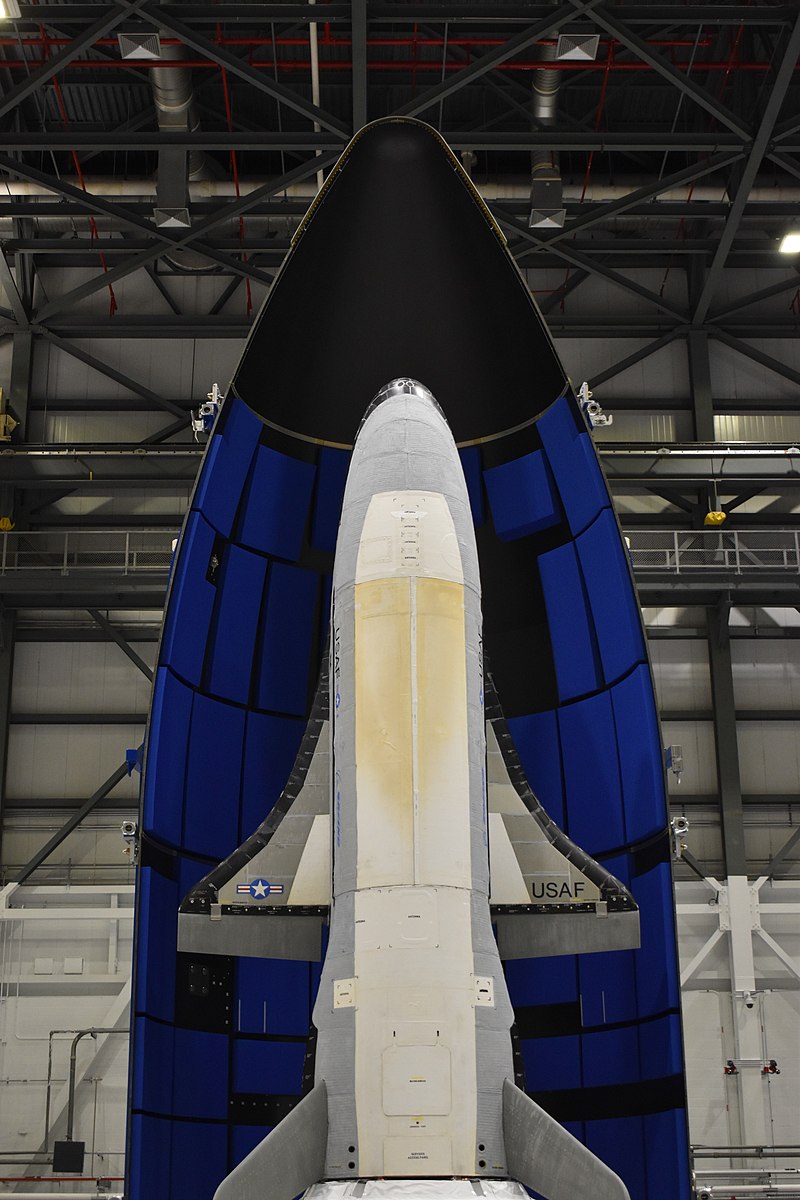
The U.S. Air Force commissioned Boeing to construct the unmanned Boeing X-37 also known as the Orbital Test Vehicle in 1999. This space vehicle was about a quarter the size of the Space Shuttle. The project was transferred from NASA to the Department of Defense in 2004.
In 2006, the Air Force announced that it would construct its own version of the X-37 called the X37B. The X-37B was designed to stay in orbit for up to 270 days. The stated purpose of the X-37B was to focus on “risk reduction, experimentation, and operational concept development for reusable space vehicle technologies, in support of long-term developmental space objectives”. The X-37B began its operational life in 2010. Most of the information about the X-37B and its missions is classified.
An X-37B is scheduled to be launched on May 16th of this year from Cape Canaveral Air Force Station in Florida. The Department of Defense and the Space Force have provided minimal details of the mission in press releases. It will carry out missions to assess the effects of cosmic radiation and other space ‘effects” on seeds and material samples. It will also be carrying another payload in the form of an experimental system designed by the Naval Research Laboratory. This system will capture solar power and beam the energy back to Earth in the form of microwaves.
The Naval Research Laboratory’s head of beamed power has stated that this system has huge implications for long-endurance unmanned aerial vehicles. It will allow satellites to provide reliable power anywhere on Earth or even to other satellites in orbit. U.S. Naval Research Laboratory has been promoting this idea for the last year.
In October 2019 the Navy gave a three-day demonstration of the latest Navy power-beaming capability at the Naval Surface Warfare Center in Bethesda, Maryland. During the demonstration, the NRL transmitted a silent invisible beam of a two-kilowatt laser power almost a thousand feet.
Research or military outposts in remote locations currently have to rely on low power solar systems or haul heavy generators and large amounts of fuel to their locations in order to operate. With the new power beaming system, the installation would only need to have a rectifying antenna also called a rectenna in order to capture useful energy in the form of microwaves beamed from overhead. Areas that have been ravished by natural disasters could use beamed energy to aid reconstruction long before tradition electrical infrastructure is rebuilt. It could even be used to power ships at sea.
Dr. Paul Jaffe is an electronics engineer with the U.S. Naval Research Laboratory who is leading the NRL’s research into power beaming. He predicts that power beaming with open up new frontiers in terms of long-endurance unmanned aircraft. He said, “If you have an electric drone that can fly more than an hour, you’re doing pretty well. If we had a way to keep those drones and UAVs flying indefinitely, that would have really far-reaching implications. With power beaming, we have a path toward being able to do that.”
Please read Part 2 next. -

The U.S. Will Be Promoting The Artemis Accords To Cover Mining On The Moon – Part 2 of 2 Parts
Part 2 of 2 Parts
The Trump administration developed the idea of the Artemis Accords so they could avoid the treaty process at the United Nations. They want to reach a direct agreement with “like-minded nations,” partly because they believe that the usual U.N. treaty process would consume too much time. Also, the U.S. feels that involving non-spacefaring states in the negotiations would be unproductive.
Spacefaring nations are increasingly viewing space as a new military domain. The Artemis Accords are also symbolic of NASA’s expanding role as a tool of American diplomacy. The Accords are expected to stir up controversy with U.S. space rivals such as China. Jim Bridenstine is the NASA administrator. He said, “NASA’s all about science and technology and discovery, which are critically important, but I think less salient is the idea that NASA is a tool of diplomacy. The important thing is, countries all around the world want to be a part of this. That’s the element of national power.” He went on to say that participation in the Artemis program is going to be contingent on countries adhering to “norms of behavior that we expect to see” in space.
NASA is investing tens of billions of dollars in the Artemis program. The program calls for sending humans to the Moon by 2024 and building “sustainable presence” on the lunar south pole. Private companies will mine lunar rock and subsurface water that can be used to supply the lunar bases with water and oxygen. It can also be broken down into hydrogen and oxygen to fuel space vehicles.
The U.S. enacted a law in 2015 which granted property rights to resources that companies mine in outer space. No such law exists in the international community. In fact, the 1967 Treaty explicitly says that if explorers bring back materials from outer space, they have to be equally shared among the signatories of the Treaty. This has been a major sticking point for companies that are interested in mining in outer space.
Joanne Gabrynowicz is the editor-in-chief emerita of the Journal of Space Law. He said that an international agreement must precede staking out “some kind of exclusive area for science or for whatever reason. It is not anything any nation can do unilaterally and still have it be legal.”
Leaving out major space faring nations such as China, Russia and India from the Accords negotiations is a very bad idea. All three of these nations have investments in lunar exploration and plans for eventual Moon colonies of their own. What will happen if one of these countries decides that it wants to mine resources that are in an Artemis “safety zone’. It appears to me that this will be an invitation to develop military assets on the Moon which is also prohibited by the current 1967 Treaty. If a dispute breaks out over mining on the Moon and incursions of one nation into the declared “safety zones” of another nation and only one of them is part of the Artemis Accords, what institution would adjudicate the disagreement? Leaving major space players out of the Accords would appear to be just asking for trouble. -

The U.S. Will Be Promoting The Artemis Accords To Cover Mining On The Moon – Part 1 of 2 Parts
Part 1 of 2 Parts
The Trump administration is working on the legal framework for mining on the Moon under a new U.S. sponsored international agreement that they call the Artemis Accords. This effort is part of the U.S. push to acquire allies for NASA plans to put a permanent manned colony on the Moon as well as space stations near the Moon within the next decade. The U.S. civilian space agency is playing a growing role in implementing U.S. foreign policy. The draft proposal for the Accords has not yet been shared with U.S. allies.
The Trump administration and other countries that have national space programs view the Moon as a key strategic asset in outer space. The Moon also has great value for long-term scientific research that could help pave the way for future missions to Mars. Currently, activities on the Moon are governed by what many consider to be international space law that many see as outdated.
The Artemis Accords are named after NASA’s new Artemis Moon program. They suggested that proposed “safety zones” could be put into place around future Moon bases in order to prevent damage or interference from rival countries or companies operating nearby. The Accords also are intended to provide a framework under international law for companies to own the resources that they mine.
In the near future, U.S. officials intend to open formal negotiations on the accords with space partners such as Canada, Japan, and European countries, as well as the United Arab Emirates. These are countries that the U.S. believes share the same interests as the U.S. in lunar mining.
While Russia is currently a major U.S. partner in the international Space Station, it will not be an early partner in the adoption of the Accords. The U.S. Pentagon increasingly views Russia as hostile because lately they have been maneuvering their satellites to approach U.S. spy satellites in Earth orbit.
The U.S. is currently a member of the 1967 Outer Space Treaty. U.S. officials view the idea of “safety zones” as an implementation of one of the highly debated articles of the Treaty. The Treaty states that celestial bodies including the Moon are “not subject to national appropriation by claim of sovereignty, by means of use or occupation, or by any other means.”
The suggested “safety zones” would vary in size depending on the operation being carried out at the chosen site. They would allow coordination between space actors without technically claiming territory as sovereign. One source said anonymously that, “This isn’t some territorial claim. The idea is if you are going to be coming near someone’s operations, and they’ve declared safety zones around it, then you need to reach out to them in advance, consult and figure out how you can do that safely for everyone.”
I have a concern that this “not technically sovereign” idea is just a semantic game. If a nation says that a particular area of the surface of the Moon is under their control and that other nations cannot enter it or exploit any resources in the area without the permission of the declared user of that area, it is a sovereign territorial claim regardless of what they call it.
Please read Part 2 -
SpaceX Is Testing The Fifth Version Of It’s Starship Spacecraft – Part 2 of 2 Parts
Part 2 of 2 Parts
Initially, SpaceX had intended to hop the SN3 about five hundred feet. However, since the collapse of the SN3, SpaceX now intends to make test hops with the SN4. If they do, they will only be small hops that do not require that the Raptor engines be relit.
Elon Musk, founder of SpaceX, explained that the SN4 will not be equipped with the control surfaces that are necessary in order for the Starship to perform flight where the engines are shut off and the relit. SpaceX is working on flaps, actuators and static aero design to be added to the SN5 or SN6 versions of the Starship.
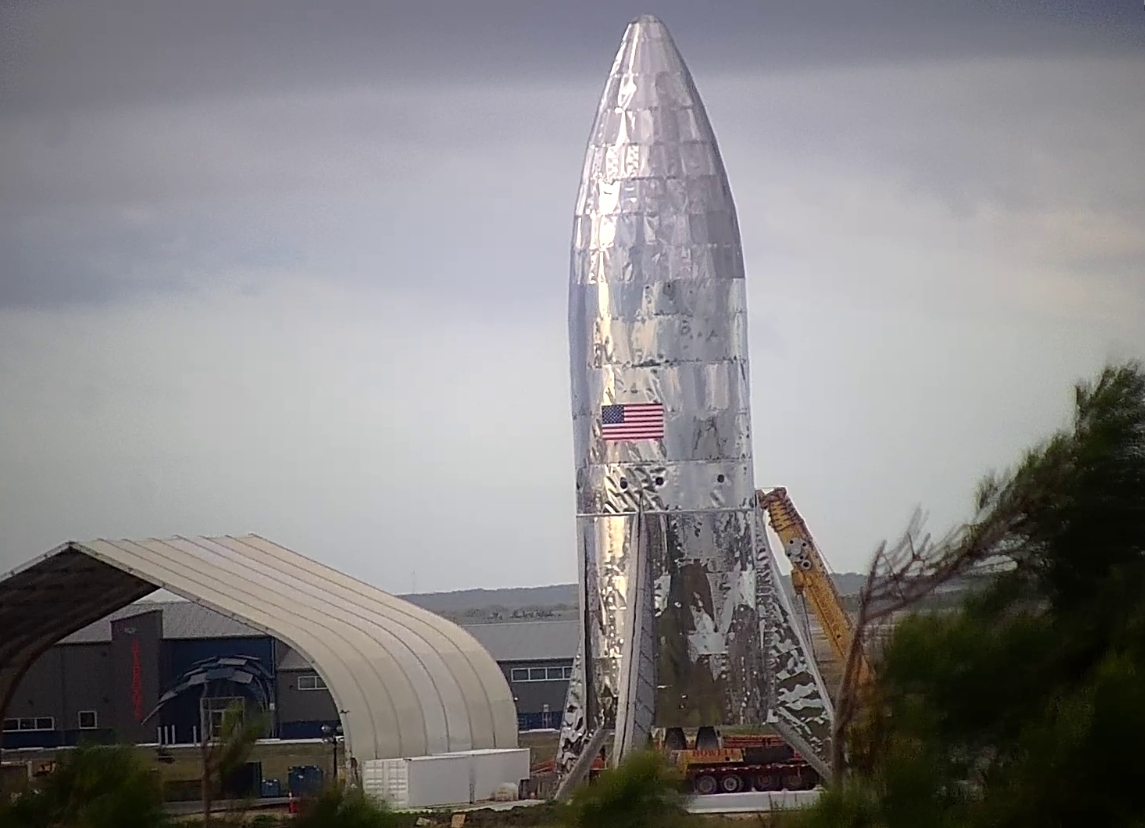
Both the SN5 and the SN6 will also have nosecones which the SN4 does not have. The nosecones will not only containe the payloads for the operational Starships but they will also contain the liquid oxygen header tank. Putting the header tank in the tip of the nosecone will help to keep the center of mass of the vehicle forward. This will be important when a Starship is descending through atmosphere without a payload aboard.
The construction of the SN5 version of the Starship has already begun. Many of the sections have been seen inside the big production tents at SpaceX’s Boca Chica facility. In addtiong, a piece of the SN5 tank section was moved into the high bay just a few hours after the SN4 was rolled out to the launch pad on Thursday afternoon.
As mentioned above, the SN4 will not be equipped with a nosecone. The vehicle does have several heat tiles installed on its surface. A cluster of tiles has been installed along both the engine section and towards the top of the tank section. The ultimate production version of the Starsship will have one entire side of the vehicles covered in heat tiles. This will allow the vehicle to safely reenter the Earth’s atmosphere and eventually the atmosphere of other planets. Including heat tiles on the SN4 will permit SpaceX to gain experience with the process of mounting tiles and verify that the tiles will stay properly secured to the Starship during testing.
Elon Musk has great plans for the production and use of the Starship that his company is working on. First of all, he wants to ultimately turn out one Starship every three days at his factory. Musk is known for his optimistic projections of production schedules and I fear that this may be the case with the Starship.
One of the primary uses of the Starship according to Musk will be the colonization of Mars, a goal of many space enthusiasts. The huge life capacity of the Starship will be required to move all the people and supplies Mars. Musk believes that thousand of people will volunteer to go to Mars permanently. As much as I have been fascinated by the exploration of space since I was a child, I have come to understand just how hostile Mars would be for human habitation. With a thin, mostly carbon dioxide atmosphere, extremely low surface temperatures, no magnetic field to fend of radiation, and perchlorates in the sand which are carcinogenic compounds, Mars makes Antarctica look like Palm Springs. I find it difficult to believe that we will see Martian settlements in our lifetimes. -

SpaceX Is Testing The Fifth Version Of It’s Starship Spacecraft – Part 1 of 2 Parts
Part 1 of 2 Parts
SpaceX has been working on the design of a huge lift vehicle that they call the Starship. As it says on the SpaceX website, “SpaceX’s Starship spacecraft and Super Heavy rocket represent a fully reusable transportation system designed to carry both crew and cargo to Earth orbit, the Moon, Mars and beyond. Starship will be the world’s most powerful launch vehicle ever developed, with the ability to carry in excess of 100 metric tons to Earth orbit. Drawing on an extensive history of launch vehicle and engine development programs, SpaceX has been rapidly iterating on the design of Starship with orbital-flight targeted for 2020.
They developed four designs into full scale prototypes referred to as Mk1, SN1, SN3 and SN4. The Mk1, SN1 and SN3 have all failed cryogenic proof testing in which the Starship is filled with liquid nitrogen to verify that its tanks can withstand flight pressure. The SN2 prototype did pass cryogenic proof testing but it was not a full version of the design. It was only a partially assembled nitrogen tank. SN4 is being prepared for cryogenic proof testing next week.
It is very important for SpaceX that the cryogenic proof testing of SN4 be successful. When it is readied for an actual launch, this will be one of the first phases of launch preparation. The problems with Nk1and SN1 involved faulty welding. The SN3 failure was attributed to a test configuration mistake that resulted in a major pressure difference between the liquid oxygen and methane tanks. In the SN3 test, the liquid oxygen tank was crushed by the full methane tank.
The SpaceX teams are aiming to test the SN4 this evening. A proof test with nitrogen at ambient atmospheric temperature was successfully performed yesterday. These test schedules are very fluid and often subjected to delays. If the SN4 passes the cryogenic proof test, then engine testing will follow in a few days.
SpaceX currently has three Raptor engines that are ready to test. The engines are not installed in the Starship until after the cryogenic proof test has been carried out because those tests use hydraulic pistons to simulate the forces that the Raptors exert during actual flight. If SpaceX can install the Raptor engines they will need to be subjected to extensive tests. These will include testing of gimbals, ignitors and fuel pre-burners. Following this testing, SpaceX will ready to run static fire single engine tests or they may go directly to static fire testing with all three engines simultaneously.
SpaceX has had problems with static fire testing on their Starhopper vehicle. They may have to make a few attempts on with the Starship SN4 to get it right. It will be the first time that a Starship has actually been filled with cryogenic methane and liquid oxygen. It is likely there will be at least minor problems with the ground support equipment that will have to be solved ahead of the static fire test. If SpaceX can successfully make it all the way to static fire testing of all three Raptor engines, they may go on to test the Starship SN4 on actual short hops.
Please read Part 2 next -

New Fuels Are Being Developed For Satellite Propulsion – Part 2 of 2 Parts
Part 2 of 2 Parts
HyproGEO is a project coordinated by Airbus, a European aerospace company. This project is working on a non-toxic propulsion system focused specifically on satellites in geostationary orbit around the Earth. These satellites travel at about twenty-two thousand miles per hour and remain in position over a particular point above the Earth. They are typically used for communications and broadcasting. Dr. Frischauf is with SpaceTec Partners which is a member of the HyproGEO consortium. He said, “To get up there, it takes quite a lot of energy.”
Right now, the energy needed to get satellites out to geosynchronous orbit is provided by hydrazine-based fuels. HyproGEO is working on a hybrid propulsion system that utilizes hydrogen peroxide instead of hydrazine. The new fuel is ninety eight percent hydrogen peroxide and is highly acidic. However, it is still much less dangerous to work with than hydrazine. Hydrogen peroxide also breaks down into oxygen and water. This process does not release fumes that are toxic to humans.
Geostationary satellites are designed to operate for a decade or longer. This means that their propellants which are after launch to maneuver and change orbit must be able to operate reliably and safely for at least a decade and a half. Frischauf said, “You have to make sure that it will still be running after 15 years, so it should be a simple system, because if it’s complicated there’s always a risk that something breaks.”
The HyproGEO solution to satellite propulsion is a hybrid system. Hydrogen peroxide is passed over a catalyzer which results in the production of very hot oxygen and water vapor. The oxygen can be used to propel a satellite or it can be used to ignite another substance which will provide extra boost. Frischauf said, “When you control the flow of the oxygen, you can control the thrust of the engine.”
The HyproGEO team successfully constructed a test engine which could store the new propellant. Then they designed an engine that used the fuel as intended by their design. That work was completed in 2018. Since then a Norwegian defense company named Mammo has sent a rocket to an altitude of sixty-six miles in three minutes with the HyproGEO hybrid engine. This performance is similar to the performance of typical suborbital rockets using traditional propulsion systems.
These new propellants and engines are not just a benefit to those who must work with the old toxic fuels. If widely adopted, the new fuels will make the whole infrastructure more efficient and cheaper. Kneižys says that the NanoAvionics EPSS system costs about one third as much as traditional satellite engines that use hydrazine-based fuels.
If these new fuels and engines are so great, why have they not been adopted more widely by now? One major problem has been that the new fuels and systems have not been able to sustain long-term firing that is needed to raise satellites from low Earth orbits to geosynchronous orbit. HyproGEO has managed to solve this particular problem which should speed adoption.
The existing satellite launch industry is heavily invested in the use of hydrazine. This infrastructure would have to change in order to stop using hydrazine and that will cost money and time. Frischauf said, “It always takes a bit of an impetus, a bit of a push to make sure the new technology can prevail.” -

New Fuels Are Being Developed For Satellite Propulsion – Part 1 of 2 Parts
Part 1 of 2 Parts
Space industries are always looking to find better propellants for satellites. The current commonly used propellant is hydrazine but it is highly toxic. Developing new propellants for satellites to replace hydrazine would make launching and handling of satellites much safer but it would also require change to current systems which be expensive and difficult.
The number of satellites in Earth orbit has been rapidly increasing with even more scheduled for future launch. Getting those satellites into Earth orbit is only part of the necessary effort. After a satellite has been launched into its chosen orbit, it needs to have a way to propel itself so it can move if it needs to avoid space trash in orbit. It also needs to compensate for the drag effect of thin atmosphere to stay in orbit. Eventually, it should be deorbited to be disposed of and some sort of propellent would be required to accomplish that.
The current standard propellant for satellites is a hydrazine-based fuel. Exposure to high levels of hydrazine can cause a variety of health problems which include possible damage to liver, kidneys and central nervous system. Hydrazine is violently explosive as required for a propellant. If it spills before a satellite is launched it can be a public hazard.
Preparing a hydrazine-fueled satellite for launch is a difficult and hazardous activity which requires special precautions for anyone working on it. This includes a garment like a spacesuit to ensure that if something goes wrong and the fuel is spilled, the wearer will not breath any hydrazine.
Erikas Kneižys is the Chief Design Officer at NanoAvionics, a spacecraft equipment manufacturer based in Europe. He said “Hydrazine is pretty nasty to work with from a health and safety perspective, so we’re seeing a lot more interest in these sorts of new propellants.”
In 2011, the European Chemicals Agency added hydrazine to its list of “substances of very high concern.” This indicates that the use of hydrazine may be restricted in the near future.
NanoAvionics specializes in technology for nanosatellites including CubeSats. CubeSats are miniature satellites made from cube-shaped units about four inches on a side. They are typically built from off-the-self components and weigh about two pounds. NanoAvionics say that there has been a three hundred percent increase in the number of small satellites launched between 2016 and 2020. As the number of small satellite launches increases so does the demand for a better propellant for them. Kneižys said “There were basically no products when looking at the CubeSat market and when looking especially at propulsion using. So we’ve seen this niche and started working on it.”
NanoAvionics has a project named EPSS dedicated to developing a less dangerous propellant based on ammonium dinitramide for small satellites. This is a compound composed of nitrogen, oxygen and hydrogen. The new technology involving ADN is referred to as a monopropellant. This process passes the fuel over a catalyst that causes it to decompose. This decomposition produces heat and gas that can propel a satellite. Other small satellite propulsion systems use a bipropellant approach in which two liquids are kept in separate tanks that ignite when they are mixed.
The use of a bipropellant increases risks during manufacture because the bipropellant fuels could ignite accidentally during handling. Kneižys said, “In our monopropellant you have to go miles to make sure it burns, so it’s relatively benign and stable compared to bipropellant systems.”
Better propellants would be a great benefit for small satellites but bigger satellites would also be able to make use of such new propellants.
Please read Part 2 next