Part 2 of 2 Parts
Lieutenant General John Shaw is the commander of the Combined Force Space Component Command as well as the commander of the U.S. Space Force’s Space Operations Component Command. He said that when the Pentagon first began to build satellite systems for command and control, they built them as if space was a benign domain. But potential enemies were quick to respond to the U.S. growing reliance on space for expanding U.S. military capabilities. This, in turn, led the administration of President Trump to create the U.S. Space Force as a separate military branch in 2019.
Now that Joe Biden has been declared to be the next President of the U.S., that raises the question of how much U.S. space policy may change under his administration. Neither Townsend nor Shaw raised this issue. Saadia Pekkanen is the co-director of the Space Policy and Research Center. She said that Biden was likely to continue current space policies. She said that “If you are imagining that there might be a radical shift in space policy, I don’t quite see that.”
Senator Maria Cantwell, D-Wash., pointed out that Congress still has to approve a significant piece of legislation dealing with space policy. She said, “I can’t promise you that it’s going to get done in a lame-duck session of Congress, but if it doesn’t, I will guarantee you it will be done in the very early part of 2021.” Cantwell is the ranking member of the Senate Commers, Science and Transportation Committee. She said that the authorization bill would smooth the way for NASA to increase its support of landing systems that will be able to put astronauts on the Moon’s surface. That could include the Blue Origin landing system under development in collaboration with industry partners Lockheed Martin and Northrop Grumman.
The senator said that Blue Origin which is based in Kent, Washington has become a very important player the space industry in Washington state. It accounts for almost two billion dollars of the state’s economic activity annually. Other prominent members of Washington’s space industry include SpaceX which is constructing its fleet of Starlink satellites at a facility in Redmond, Washington; and Aerojet Rocketdyne’s operation, also in Redmond, is building rocket thrusters for future NASA missions. Cantwell said, “It’s not surprising that all of those efforts have led recently to our state being called ‘the Silicon Valley of Space’.”
With respect to future space exploration, the NASA Artemis program to put astronauts on the Moon in the near future is one of the most ambitious. The Trump administration has been putting pressure on the NASA to carry out the first crewed landing on the Moon by 2024. Cantwell commented that this date might slip. She said, “We’re very excited about Artemis in general. … There’s not always consensus about when and what time frame we should have to meet this Artemis goal. Hitting the 2024 deadline would require an enormous amount of resources.”
Wendy Whitman Cobb is an associate professor of strategy and security studies at the U.S. Air Force School of Advanced Air and Space Studies. She said that the Artemis program was likely to move forward even though the White House has changed hands. She did add that the timetable might change. Cobb said, “A Biden administration might be a little bit better at letting that go a little bit. … If anything, I think we might see a little bit more emphasis on the commercial capabilities and commercialization of space on the part of NASA. That could be, just because there’s that natural sort of flow over from Vice President Biden’s experience with the Obama administration.”
Category: Uncategorized
-

Space Symposium At University Of Washington Discusses Necessary Space Law – Part 2 of 2 Parts
-

Space Symposium At University Of Washington Discusses Necessary Space Law – Part 1 of 2 Parts
Part 1 of 2 Parts
During the Cold War, the doctrine of mutually assured destruction via nuclear holocaust was practiced to prevent the use of nuclear weapons. Now there is a new possibility of mutually assured destruction with respect to the cloud of satellites around the Earth. Brad Townsend is a space strategy and policy adviser to the leadership of the U.S. Joint Chiefs of Staff. He warned them about anti-satellite weapons at a virtual symposium sponsored by the University of Washington’s Space Policy and Research Center.
Townsend said that China and Russia are already working on ways to disable the satellites of other nations in the event of a future war. One of the big problems with such ASATs is that they may unintentionally trigger a catastrophic chain reaction of out-of-control orbital debris. This type of event is called the Kessler syndrome. It has been exploited in the scripts of movies such as “Gravity” and novels such as “SevenEves.” Unfortunately, the Kessler syndrome is not just science fiction.
Townsend said, “If nations start arming with ASATs as a way to deter other nations from attacking their orbital assets, they risk creating a new form of mutually assured destruction.” He had hoped that the danger of setting off the Kessler syndrome would have caused the nations with space programs to back away from the development of ASATs. “But as India’s 2019 test demonstrated, it hasn’t.”
Townsend speculated on what could be done about the situation. One possible solution would be to create an international system for sharing information about satellites in Earth orbit which could serve an important role in preventing satellite collisions. Another possible solution would be to encourage the creation of systems that would be able to move satellites to orbital graveyards once they are no longer operational. Northrop Grumman’s MEV-1 satellite tug is an example of such a system.
In order to prevent an intentional attack on satellites, Townsend suggested that the nations of the world would have to agree to ban the use of ASAT weapons just like the use of biological weapons has been banned. He said, “The time is right for de-escalation efforts before we have that future event.”
In past international discussions about the development of space weapons, the U.S. has favored an approach know as transparency and confidence-building measures, or TCBM. On the other hand, China and Russia have proposed their own treaty on the prevention of putting weapons in outer space, PPWT. Each side has rejected the proposals of the other side.
Matthew Stubbs is an expert in space law at the University of Adelaide in Australia. He said that there is “considerable pessimism about the prospects of multilateral rulemaking for space at the moment.” He went on to said that the most probably scenario for dealing with the issue would involve a series of bilateral and multilateral agreements. NASA is working on such an approach with the Artemis Accords which are a set of agreements that are expected to govern future lunar exploration.
Please read Part 2 next -

Seven Nations Sign Onto The Artemis Accords With The U.S. For Lunar Exploration – Part 2 of 2 Parts
Part 2 of 2 Parts
It is notable that Russia and China, two of the most influential spacefaring nations in the world, are not included among the signatories of the Artemis Accords. Bridenstine said that more countries would be signing on to the Artemis coalition but that it is not yet clear whether Russia would ever be among them. At an IAC session, Dmitry Rogozin, who is head of the Russian space program, complained that the lunar Gateway project is “too U.S.-centric.” It will be guided by a multilateral agreement instead of a series of bilateral agreements.
Rogozin said that “Russia is likely to refrain from participating in it on a large scale.” He also said that he might consider changing his attitude on participation if the decision-making process for the Gateway changed to put more emphasis on international cooperation. Responding to the Russian statements, Bridenstine said that the Gateway agreement would follow the model set by operations on the ISS and that he was “open and interested” in feedback from the Russians.
China is considered to be a special case because NASA is currently prevented from conducting bilateral talks with their Chinese counterparts due to national security concerns. He said, “NASA, as an agency, always follows the law, and the law right now prohibits us from engaging China on bilateral activities. If China’s behavior were to be modified in a way that Congress, Republicans and Democrats, come together and say, ‘Look, we want to engage China,’ NASA stands ready.”
The text of the Artemis Accords suggest that they could apply to celestial destinations beyond the Moon. This could include Mars, comets and asteroids. Mike Gold is the associate administrator for NASA’s Office of International and Interagency Relations. He said that such further-out space missions would have to be covered more fully in future agreements that build on the foundations of the Accords.
Gold said, “Regardless of where you go in the solar system, we still think they’re very applicable. But again, we’re modest enough to know, like the U.S. Constitution in many ways, that changes will need to be made. We’ll learn from our experiences, and we look forward to having those problems. They’re good issues to have.”
The Artemis Accords contain the following principles
• Peaceful purposes: All activities will be conducted for peaceful purposes in accordance with the 1967 Outer Space Treaty.
• Transparency: Partner nations will conduct their activities in a transparent fashion to avoid confusion and conflicts.
• Interoperability: Partner nations will strive to support interoperable systems to enhance safety and sustainability.
• Emergency assistance: Partner nations commit to rendering assistance to personnel in distress.
• Registration of space objects: Partner nations should adhere to the Registration Convention on identifying their space objects.
• Release of scientific data: Partner nations commit to the public release of scientific information.
• Preserving heritage: Partner nations commit to preserving sites and artifacts on the moon that have historical value.
• Space resources: Extracting and utilizing space resources is key to safe and sustainable exploration, and signatories affirm that such activities should be conducted in compliance with the Outer Space Treaty.
• Deconfliction of activities: Partner nations commit to preventing harmful interference and supporting the principle of due regard, as required by the Outer Space Treaty.
• Orbital debris and spacecraft disposal: Partner nations commit to planning for the safe disposal of space debris. -

Seven Nations Sign Onto The Artemis Accords With The U.S. For Lunar Exploration – Part 1 of 2 Parts
Part 1 of 2 Parts
Seven countries have joined the United States to collaborate in NASA’s Artemis program to put astronauts on the moon as early as 2024. The nations who have joined Artemis include Australia, Britain, Canada, Japan, Italy, Luxembourg and the United Arab Emirates. The Artemis Accords commit the signing nations to adhere to a set of principles that range from ensuring the interoperability of space hardware to the protection of lunar heritage sites and space property rights.
The signing was announced by NASA administrator Jim Bridenstine and representative of other signatory nations last week as part of the International Astronautical Congress. During the Congress, Bridenstine said that the Accords will serve as the “preamble of bilateral agreements between the United States and all of our international partners as we go sustainably to the moon with commercial and international partners.”
Each signatory nation will be obligated to ensure that the commercial partners under their jurisdiction observe the requirements of the Artemis Accords. The signers of the Accords will be required to register the objects that they are launching into space. They must also provide public notification about the locations and nature of their operations. This is called “due regard.”
If it happens that signatories do not adhere to the conditions laid out in the Accords and any follow-up agreements, they could be invited to withdraw from the Accords. Bridenstine said, “There’s a lot of pressure that can be brought to bear.” He did not give any details on the enforcement process. Bridenstine said that the Artemis Accords were a way to “operationalize” the 1967 Outer Space Treaty, which governs international activities in space.
He joked in a NASA webcast when the Accords were signed that “The Outer Space Treaty is over 50 years old, but it doesn’t look a day over 35. The Accords both reinforce and implement the obligations of the Outer Space Treaty. For the first time, we are establishing consequences for Outer Space Treaty compliance.”
Because the Artemis Accords do not have the status associated with treaties, they do not have to be ratified by the U. S. Senate. Bridenstine said that NASA had been making use of bilateral agreements with individual nations in order to speed up the process of preparing for the first Artemis astronauts to land on the Moon in 2024. He said, “We have a mandate to go quickly, and at the same time bring on international and commercial partners. And that’s what we’re trying to do.”
The agreements covering landing astronauts on the Moon are separate from the multilateral agreement that governs operations on the International Space Station. There is a similar multinational agreement that applies to the Gateway which is a NASA-led project to construct an outpost in lunar orbit.
Megan Clark is head of the Australian Space Agency. She was at the Congress and said, “We’re so proud that our agency, just two years old, can stand shoulder to shoulder with NASA and our counterparts from across the globe.”
Please read Part 2 next -

NASA Scientists Find Evidence Of Deposits Of Metal Beneath The Surface Of The Moon
One of the big questions about exploration of the Moon is whether it contains are valuable assets that can be mined. Water is a good bet. Ice has already been discovered and water can be split into oxygen and hydrogen which can be used for rocket fuel. Another good bet is helium-3 which is rare on Earth but common on the surface of the Moon. Research on fusion reactors for power generation suggests that helium-3 might be a good fuel. Now we have reports that there may be substantial quantities of metals to be mined.
The NASA Lunar Reconnaissance Orbiter spacecraft carries a Miniature Radio Frequency instrument. A team of scientists using the device have found that there may be much more subsurface metals beneath the Moon’s surface that previously thought.
Some researchers think that this finding could require a revision of theories of the formation and evolution of the Moon. The current dominant theory says that there was a collision between the Earth and a Mars-sized object that produced in a cloud of debris. Gravitational forces drew the dust and debris together and formed the Moon.
This theory had been invoked to explain why the composition of the Moon seems so similar to that of the Earth. However, the lunar highlands that make up eighty percent of the Moon’s surface are covered with a bright silicate layer that appears to contain far less metal-bearing minerals than would be found on the surface of the Earth. On the other hand, the darker areas and plains or “maria” of the lunar crust which were formed by volcanic processes seem to have more metals that expected.
The Mini-RF instrument on the NASA’s Moon Orbiter discovered that beyond a certain size, the bigger the crater, the more the material it contained was able to transmit electric fields. This is property is known as the “dielectric constant”. Scientists say that there is a direct connection between this constant and the concentration of metal minerals including iron and titanium oxides. However, craters that are between three and twelve miles wide do not show such a change in the dielectric constant.
Essam Heggy is the co-investigator of the Mini-RF experiments at the University of Southern California and also the lead author of a paper published in Earth and Planetary Science Letters last week. He issued a statement that said, “It was a surprising relationship that we had no reason to believe would exist.”
The hypothesis of the NASA scientists formed to explain these experimental results is that meteors excavated metals from below as they punched craters into the lunar surface. If they are right, there are huge deposits of useful metals buried a few hundred yards beneath the surface of the Moon. In fact, the deeper we dig into the Moon, the more iron and titanium oxides we will find.
Noah Petro is the LRO project scientist at NASA’s Goddard Space Flight Center, but he was not involved in the research. He said, “This exciting result from Mini-RF shows that even after 11 years in operation at the Moon, we are still making new discoveries about the ancient history of our nearest neighbor.”
Noah Petro, LRO project scientist at NASA’s Goddard Space Flight Center, who was not involved in the research, said in the newer statement. “The MINI-RF data is incredibly valuable for telling us about the properties of the lunar surface, but we use that data to infer what was happening over 4.5 billion years ago!” -
Russia Is Exploring Mating A Nuclear Reactor With An Ion Engine For Space Propulsion – Part 2 of 2 Parts
Part 2 of 2 Parts
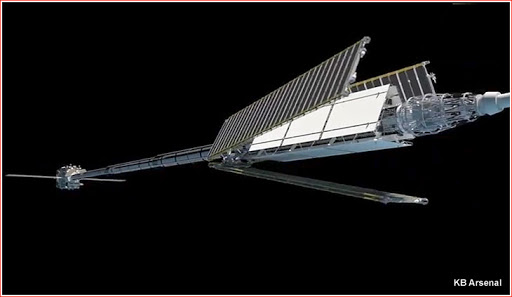
With a large portfolio of nuclear technology resulting from decades of research as well as a big budget, the Russian Ministry of Defense has apparently become the primary backer of the first post-Soviet attempt to construct a nuclear power-generating system for space propulsion. Of course the work on the reactor was largely classified, but in 2020, KB Arsenal released photos of what appeared to be the assembly of a full-scale TEM spacecraft or at least a prototype and a computer animation of the deployment of such a craft in Earth orbit.
The heart of the TEM space tug is the onboard nuclear reactor which will generate heat. The heat will be converted into electrical power either through some sort of mechanical turbine system or via a thermal emission method which will not require any moving parts. A thermal emission system is less effective than a mechanical turbine. However, it is far simpler and very familiar to the Russian space industry. From the recently released materials, it appears that a thermal emission conversion system will be used on the TEM.
The excessive heat that will be generated by the operation of the reactor will be released into space with a system of radiators. The images released of the TEM appear to feature a trio of main and three auxiliary radiators. The smaller panels will probably used to service the tradition needs of service systems aboard the spacecraft. The larger deployable and stationary radiators will probably be used exclusively to remove excess heat from the nuclear reactor. The computer animations of Earth orbit deployment showed a very complex three-stage process for the deployment of the main radiators.
The images that have been released of the TEM appear to show that a heat-carrying cooling fluid will be pumped through the radiation system by a turbine. It is definitely a less progressive technology than the capillary heat pipe radiating system which was originally planned for the spacecraft. Russia was testing such a capillary cooling system aboard the Mir space station twenty years ago.
In order to protect all the systems aboard the spacecraft from harmful radiation, the nuclear reactor will be placed behind a cone-shaped shield which will form a protective conical “shadow” free of dangerous particles. To further increase the safe zone, the reactor is attached to what appears to be a four-section telescopic boom made of a light-weight composite material. The boom deploys to its full length after the space tug separates from the launch vehicle in orbit.
According to the published material, the nuclear reactor on the TEM spacecraft would be active only after the craft reached an altitude between three hundred and seventy-five miles and five hundred miles. This is far enough above the Earth so that the atmosphere is too thin to cause the orbital decay and reentry of a stalled satellite. In the meantime, all the service systems of the space tug and its payloads can still be supplied with power from a pair of solar panels deployed on the sides of the propulsion module immediately after entering Earth orbit.
The images released by KB Arsenal in 2020 showed some of the key components of this huge vehicle including the propulsion module, stationary and deployable radiators and the deployable boom which will carry the reactor. There were no photos of the nuclear reactor, but it was shown in the computer animations that accompanied the photographs. It appears that even without its payload, the Russian TEM would be a twenty to thirty ton vehicle. This would require either an Angara-5M or Angara-5V heavy rocket to reach an initial orbit from the Vostochny spaceport. One image produced by GKNPTs Khrunichev in 2016 showed the Angara-5V rocket with a Briz-M upper stage carrying the TEM vehicle. -

Russia Is Exploring Mating A Nuclear Reactor With An Ion Engine For Space Propulsion – Part 1 of 2 Parts
Part 1 of 2 Parts
Space faring nations are now engaged in a race to dominate the region between the Earth and the orbit of the Moon. After years of hints but few details, a major Russian developer of military spacecraft has suddenly publicly displayed the first pictures of a huge nuclear-powered space transport which is reportedly being constructed at the company’s facilities in St. Petersburg. The KB Arsenal Design Bureau is known for the nuclear-powered satellites it built for the Soviet Union. One of its satellites crashed in the Arctic region of Canada in 1977. The KB Arsenal company is the prime contractor for the new Russian spacecraft.
A set of photos and computer-generated images originating from KB Arsenal appeared on the Internet in 2020. This material clearly revealed the latest version and planned operation of a very big space tug propelled by electric engines and powered by a nuclear reactor. The project is officially named the Transport and Energy Module, or TEM, has been well known to observers of the Russian space program from more than ten years.
The roots of the project can be traced to the dawn of the Space Age. The TEM concept is trying to combine a nuclear reactor with an electric rocket engine. The electric propulsion system heats up and accelerates ionized gas to create a jet that generates thrust for the craft. This type of engine is known as either an ion or plasma engine. When measured per unit of spent propellant mass, electric rocket motors are much more efficient than traditional liquid or solid propellant rockets. However, the thrust produced by such engines is relatively low at any particular time. In addition, they require a great deal of electricity to operate. For this reason, until recently, the use of electrical propulsion for space flight was mostly limited to orbital adjustment systems or to deep-space mission. For deep space missions, the spacecraft can take advantage of ion engines low thrust over an extended period of time.
In order to scale up the operation of the electric thrusters with their big power demand, engineers have been considering the replacement of heavy and bulky solar panels with nuclear power sources. Nuclear reactors could supply plenty of electricity for years or even decades. They would not be dependent on solar radiation which is weak in the remote cold regions of the Solar System. Deep space missions such as Voyager, Cassini and many other required nuclear thermoelectric systems to power them.
However, the development of nuclear reactors for use as space propulsion systems still had to take place on the surface of the Earth. Environmental and safety concerns served to slow down such development because of fears that test launches might fail and result in the debris from damaged or totally-destroyed nuclear reactors falling back to Earth. Even so, by the early Twentieth Century, the Russian military showed renewed interest in the great capacity of nuclear reactors that could provide electricity not just for propulsion but also for other equipment onboard large spacecraft. This could include powerful radar antennas intended for surveillance of both the surface of the Earth and objects in Earth orbit.
Please read Part 2 next -

NASA Considering Nuclear Fission For Manned Lunar Bases And Space Propulsion – Part 3 of 3 Parts
Part 3 of 3 Parts
As NASA has proceeded with its propulsion and Kilopower projects, non-proliferation advocated have complained about NASA’s continued interest in using HEU. The American Nuclear Society hosted a debate on that topic at its annual meeting last June. The Society has generally supported the use of nuclear power for space propulsion in the past, it has decided to develop a position statement by spring of 2021 on whether or not to favor the use of LEU.
Among the attendees at the ANS meeting was U.S. Representative Bill Foster who is a former Fermilab physicist. He argued that proceeding with HEU would set a dangerous precedent. He added that, “If all of the spacefaring nations start using HEU reactors in space, then this would involve utilization of a significant amount of weapons grade material.” On the other hand, if the U.S. develops a LEU-based reactor design for space propulsion it could become a “de facto standard.” Foster also suggested that the high costs of security measures that would have to be implemented for handling HEU could outweigh any advantages of using HEU for propulsion.
Alan Kuperman is a policy scholar affiliated with the Nuclear Proliferation Prevention Project. He pointed to U.S. efforts since the 1970s to minimize the use of HEU in civilian applications. He argued that they are “based on the logic of no exceptions. If we say, ‘well, we’re going to have exceptions,’ then other countries are going to say, ‘well, we want exceptions too,’ and then the whole thing falls apart.”
Among those attendees advocating in favor of HEU fuel, Kilopower chief reactor designer David Poston said that in his experience, regulators were most concerned about the possibility of a criticality accident resulting in a high-yield event. He said that HEU systems tend to mitigate such a concern.
Len Dudzinski is the NASA program executive for radioisotope power systems. He said that LEU reactors are just not powerful enough for certain potential missions such as drilling through thick ice sheets on the moons of Europa or Enceladus.
Bhavya Lal is a member of the National Academy study committee. She said that choosing between HEU and LEU is ultimately a political one and not a technical one. She mentioned that other countries might pursue HEU systems regardless of what the U.S. does. She advocated for not adopting a blanket ban on HEU. She said, “In my view, it would be prudent that we retain flexibility and allow the use of HEU in space systems only where the mission is not possible without HEU or where HEU is a significant enabler of mission scope or objective.”
The international Outer Space Treaty prohibits the placing of nuclear weapons in Earth orbit. If HEU is commonly used for space propulsion, some nations may launch radioactive materials into space with the claim that they will be used for space propulsion when they are actually intended to be used as weapons. This is a major area of concern. -

NASA Considering Nuclear Fission For Manned Lunar Bases And Space Propulsion – Part 2 of 3 Part
Part 2 of 3 Parts
NASA and the National Nuclear Security Administration have already tested a surface nuclear fission reactor as part of their Kilopower project which is dedicated to developing a system to provide up to ten kilowatts of electric power for manned planetary bases. For propulsion technologies, NASA initiated a Mars Transportation Assessment Study last October. The purpose of the study is to evaluate the merits of nuclear thermal propulsion versus nuclear electric propulsion. Both of these propulsion technologies use a nuclear fission reactor to generate heat. The NTP system will use this heat to expel gas for thrust. The NEP systems will convert the heat into electricity which will then be used for ionic engines to generate thrust.
Ryan Whitley says that one of the administration’s near-term goals is to create a capacity for the production of high-assay, low-enriched uranium that could be used for a variety of agency missions. HALEU is enriched to contain between 5% and 20% of the isotope uranium-235 by weight. Last year DoE announced plans to create a domestic supply line for HALEU fuel. He cited demand from the designers of next-generation commercial nuclear fission power reactors. NASA is currently exploring HALEU as an alternative to HEU which was used in Kilopower tests.
Whitley also said that the administration wants to leverage the commonalities between reactor designs under consideration by NASA and the DoD. The report of the Council highlighted Project Pele which is designing mobile nuclear fission reactors to power military bases and DARPA’s DRACO program which is dedicated to the development of spacecraft that can maneuver quickly and easily in the region between the Earth and the Moon. While DARPA is exploring an NTP design through its DRACO program, NASA has not chosen a particular propulsion technology. Whitley was asked at the symposium about the choice between NTP and NEP but he refused to weigh in directly because NASA was still debating the issue. He said, “There’s pluses and minuses to both, and so it’s not easy necessarily to make a clean decision there.”
In order to aid its decision making, NASA has commissioned a National Academies study committee to assess the tradeoffs associate with NEP and NTP. It will also consider the differences in using HEU fuel as opposed to HALEU fuel. Jim Reuter is the head of NASA’s Space Technology Mission Directorate. He told the committee at its first meeting last June that their study is not meant to focus on any policy issues, except when associated with the choice of a fuel.
In recent years, Congress has made NTP development a priority, led by the Marshal Space Flight Center in Alabama. In fiscal year 2020, Congress provided one hundred and ten million dollars specifically for NTP research. At least eighty million dollars of this grant was for the preparation of a flight demonstration by 2024.
Jim Reuters said that NASA has requested that in future appropriations Congress should target a demonstration in the late 2020s and should not specify that all the funding has to go to NTP. He went on to say that recent studies have led the agency to consider “looking much more strongly” at NEP and that it wishes to focus on surface power in the near term.
Reuters mentioned that NASA’s budget request for fiscal years 2021 includes one hundred million dollars for the space nuclear technology portfolio within a new line item. Sixty-two million dollars is for the development of nuclear fission surface reactors and the remainder is for propulsion research including but not limited to NTP. NASA projects its budget request portfolio will grow to two hundred and fifty million in fiscal year 2025.
The U.S. House of Representatives has proposed that NASA move ahead with research into NTP included under the one hundred and ten million budget request for its continued development in currently pending appropriations legislation for fiscal years 2021. In their report attached to the legislation, House appropriators state that they have not yet received a plan that they requested from NASA on a path toward performing an NTP flight demonstration by 2024. The Senate has not yet released a report on its NASA spending legislation for the year.
Please read Part 3 next -

NASA Considering Nuclear Fission For Manned Lunar Bases And Space Propulsion – Part 1 of 3 Parts
Part 1 of 3 Parts
I write for two blogs, one on nuclear issues and one on the space industry. Sometimes subjects overlap between the two blogs. This series of articles has to do with NASA’s interest in using nuclear power to propel spacecraft and power manned bases in space. I decided that I would post these articles in the space blog and not the nuclear blog.
NASA recently launched its Perseverance rover to Mars and officials from the U.S. Department of Energy went to Cape Canaveral to watch the launch. Perseverance is the first mission to Mars to be launched since the Curiosity rover in 2011. Curiosity is powered by nuclear batteries containing the radioactive isotope plutonium-238 which were manufactured in DoE facilities.
NASA, DoE and the White House have decided that they want to make more use of nuclear power in space exploration as plans are being made for permanently manned lunar bases and eventually crewed flights to Mars. During their recent trip to Cape Canaveral, the DoE officials held meetings with representatives from NASA at the Kennedy Space Center. The purpose of the meetings was to launce a new working group aimed at facilitating research and development of new space technologies. Included in these new projects were applications of nuclear fission as opposed to applications based on radioactive decay such as the nuclear batteries currently in use.
NASA is currently debating the comparative advantages and disadvantages between different sources for surface power and space propulsion. They are looking for commonalities with designs for nuclear reactors under development by the DoE and the Department of Defense. NASA is also working on the best choice of fuel between highly enriched uranium and fuel with less enrichment. HEU has the advantage of a very high power density but non-proliferation advocates make the argument that its use would undermine U.S. efforts to limit applications for HEU because it can be adapted for use in nuclear weapons.
The White House National Space Council released a strategy for deep space exploration on July 23rd of this year that identifies the DoE as very “critical” to the development of nuclear power and space propulsion technologies. It mentioned that NASA plans on developing a power reactor that could be used to provide electricity for a base on the surface of the Moon. It also explored nuclear propulsion methods that would significantly reduce travel time for deep-space destinations such as Mars.
Ryan Whitley is the director of civil space policy at the National Space Council. He elaborated on the administration’s work to promote nuclear technology development across U.S. federal agencies at a symposium convened this month by the American Astronautical Society.
Whitley said that NASA’s most “immediate need” is for a surface fission reactor that would enable long-duration lunar exploration. Current systems based on radioactive decay just cannot provide enough power for larger mission that will have to operate through the two week lunar night or in shadows inside a crater, He added that nuclear propulsion is a long-term priority because it will enable eventual missions to Mars and beyond.
Please read Part 2 next