Part 1 of 2 Parts
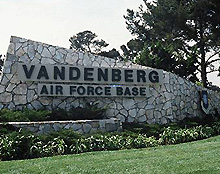
The U.S. Government has declared that it will no longer be carrying out the development and testing of anti-satellite weapons. In a public statement made during a visit to the Vandenberg Space Force Base on the central coast of California, U.S. Vice President Kamala Harris confirms that this new policy has the primary purpose of motivating other space-faring nations to also halt the development and testing of ASAT weapons. She added that the U.S. announcement represents an important step in an attempt to establish “space norms” for all nations to follow to insure peace and stability in Earth orbit.
ASAT weapons research began in the early years of the Cold War just after the end of World War II. According to the Naval Institute Guide to World Naval Weapons Systems, ASAT weapons were designed for strategic and tactical military purposes against satellites of other nations. The U. S. military has long used satellites in Earth orbit for navigation, communication and to gather intelligence on the movement of enemy forces and activities through sophisticated satellite imaging. These are known as spy satellites.
ASAT weapons have never actually been used in warfare. However, China, India, Russia and the U.S. have all demonstrated their capability to deploy ASAT weapons. So far, these ASAT weapons have only been used by space-faring nations against their own targets. Old, decommissioned and demonstration satellites have been used for these purposes.
The purpose of the ASAT tests that destroy a nation’s own satellites is to demonstrate that that nation can destroy a satellite in orbit whenever it wants to. It is saying to other nations with space programs that, “If you threaten our infrastructure, we can retaliate.” However, unfortunately, each such successful ASAT weapon test throws thousands of new pieces of debris into Earth orbit. There is so much debris already in orbit that it may soon be dangerous to any launch vehicle into space.
The risk of space junk may not seem to be that big a concern at first glance. Space is huge and it might seem that the odds of anything accidentally hitting anything else in orbit is very small. However, it is important to keep in mind that each object from fleck of paint to the International Space Station is hurtling around the Earth at enormous speed. And every single launch puts more debris in orbit.
The United Nations Office for Outer Space Affairs maintains an index of objects that have been launched into space. As of January 2022, this index contains eight thousand two hundred and sixty individual satellites. This represents an increase of almost twelve percent over the previous twelve months. As Starlink and its rivals settle down to launching their mega-constellations of communication satellites, this growth of orbital objects will only increase. There have already been collisions between satellites as well as a lot of near misses. It is not unusual for owners of satellites to have to dodge each other’s satellites.
Please read Part 2 next
Author: admin
-
U.S. Announces End Of Anti-Satellite Weapons Testing – Part 1 of 2 Parts
-
Chinese Scientists Are Working On Drone Swarms For Orbital Warfare
Chinese scientists claim that they could now launch hundreds of mini satellites called “CubeSats” from a large mothership in space with lethal precision and speed. Each CubeSat weights about two pounds. These satellites are so complex that they require artificial intelligence to control them. According to the researchers, the potential complexity of a large-scale space battle would be so immense that it would be beyond the capability of a human brain or even many artificial intelligence systems.
The report on this work was published in the peer-reviewed journal Chinese Space Science and Technology. The researchers said that creating the right AI system to control the mothership and CubeSats would have “strong economic and military value”. This report comes as China alleges that SpaceX satellites came “dangerously close” to their new space station twice last year and threatened to shoot them down. Months later, Chinese and U.S. satellites engaged in a game of “geostationary orbit cat and mouse”, according to the report.
Zhang Jin led the research detailed in the report. He said that the CubeSats could be used to patrol and defend against rogue forces in space using sophisticated AI algorithms that tell the drones where to go and what to attack. Researchers refer to this as the “multi-round greedy search strategy”. They say that they can instruct up to four motherships to attack nine hostile targets in less than a day. When tested, the AI algorithm was able to instruct CubeSats to destroy enemy targets in four minutes. The new system is extremely efficient and can plot trajectories that require the least amount of fuel and energy. This means that the swarms can remain in combat for longer. Professor Zhang said, “In the future, we will add randomness to the search strategy to overcome the limitations of the greedy algorithm and obtain global optimal results.”
The new report comes as China claims that it has developed an anti-satellite AI system that has mastered the art of deception. A trial of the lethal system found that the AI controlled three small satellites to approach and capture a high-value target. The test was repeated thousands of times.
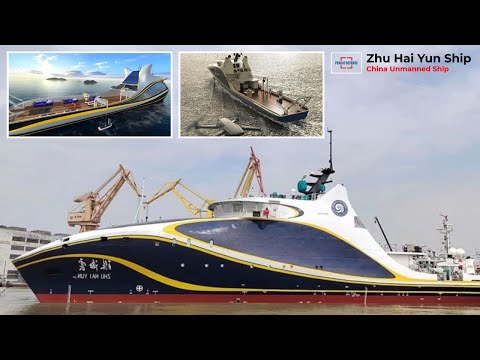
China has also launched an AI drone mothership called the Zhu Hai Yun that is able to operate and potentially launch military attacks autonomously. According to the Chinese, this new vessel is designed for marine research but there have already been fears that it could be used to launch attacks on the U.S. Navy and other potential adversaries.
The Zhu Hai Yun can hit top speeds of twenty miles per hour and can carry around fifty aerial, surface and underwater drones. China has invested heavily in the development of drone warfare systems over the past ten years. China intends to achieve military parity with the U.S. by 2049.
Brendan Mulvaney, an ex-marine, told an interviewer, “If we wait 10 or more years before we see a major conflict, the scope and scale of drones are going to change a lot. You may have effective and larger munitions coming off drones, but smaller drones could be weaponized to the point where you have this intermingling of a long-range autonomous weapon. We often think of aviation drones but there’s a whole suite of unmanned vehicles that bring more capability, making it more challenging for the adversaries.”
Seth Frantzman is a drone expert. He said, “Drones will not just slam into a ship with people on board. Drones from the air could attack machines in the sea and we could see something that looks more like Star Wars.” -

Avalanche Energy and Ultra Safe Nuclear Corporation Are Developing Small Nuclear Energy Devices For Spacecraft – Part 2 of 2 Parts
Part 2 of 2 Parts
Avalanche Energy was co-founded by ex-Blue Origin engineers Riordan and Robin Langtry. It entered the fusion race in 2018. It has patented a new lunchbox-sized fusion reactor that they call the “Orbitron.”
The device combines two existing instruments in a vacuum chamber called an “orbitrap”. The device harnesses positively charged ions in a small orbit around a negatively charged cathode, and a “magnetron”, which generates a stream of electrons. Injecting electrons into the reaction neutralizes the positive charges and permits a greater number of ions to enter the space. Packing more ions into that small a space exponentially increases the chance for the fusion reaction to occur.
The Avalanche team is refining the first prototype and plans to scale up to a bigger version in August. The main engineering challenge will be to shrink the high-voltage conductor so it can fit into the desired package but still supply enough energy to the cathodes so that the ions orbit fast enough to fuse together.
Eventually, the finished product should produce between five and fifteen kilowatts. It will be possible to combine multiple units to produce more energy. The size of the Orbitron makes it suitable for use in space travel. Weed at the DIU said that this really set it apart from the other submissions in the Pentagon contract selection process.
While Avalanche is trying to develop small-scale fusion, Ultra Safe is working on a new and improved “nuclear battery they call EmberCore. These devices contain hot, radioactive rocks that steadily release energy as they decay.
Adam Schilffarth is the director of strategy for Ultra Safe’s advanced technologies division. He said, “You can use the hot rock as a hot rock, or you can wrap power conversion technology around it to turn that heat into electricity.”
NASA has traditionally used plutonium for radioactive batteries, like the ones that power the Curiosity rover on Mars and the Voyager 1 and 2 deep space probes. However. Plutonium is an expensive, rare and dangerous material. Ultra Safe has been exploring different isotopes like cobalt-60 and thulium which can be scaled to produce ten times the energy of traditional plutonium system while being safer and more cost effective.
The first EmberCore product that Ultra Safe brought to market is the size of an apple. It operates like a “hand warmer” for lunar landers so they can survive a fourteen-day lunar night according to Chris Morrison who is the chief engineer for the EmberCore project. The final prototype which will be delivered to the Pentagon will be the size of a small filing cabinet.
Weed said that EmberCore and Orbitron might allow spacecraft to travel farther and eliminate reliance on solar panels. With such large power capacities, these devices could also spawn a new generation of spacecraft that can easily move between Earth orbit levels. This could open the door to all manner of commercial space travel, tourism and trade.
Weed said, “These new propulsion systems will enable us to have known new missions, and so it’ll affect how we employ space power. It’ll definitely be a game changer.” -

Avalanche Energy and Ultra Safe Nuclear Corporation Are Developing Small Nuclear Energy Devices For Spacecraft – Part 1 of 2 Parts
Part 1 of 2 Parts
For most people, the term “nuclear energy” conjures images of huge steaming cooling towers over massive buildings containing nuclear power reactors. However, two Seattle-based startups are developing nuclear technologies that one person could pick up and carry. They hope to produce power and propulsion for a new generation of spacecraft.
Seattle’s Avalanche Energy and Ultra Safe Nuclear Corporation have received undisclosed funding from the Pentagon’s Defense Innovation Unit to support two different approaches to small-scale nuclear power.
Avalanche is working on a nuclear fusion system while Ultra Safe intends to revolutionize nuclear isotope batteries similar to those now being used to power Mars rovers. Both of these companies are expected to deliver functional prototypes to the Pentagon by 2027.
The DIU is the Pentagon’s outpost in Silicon Valley. It works exclusively with private sector companies to adapt emerging technologies for military use. U.S. Major Ryan Weed is the program manager for the DIU’s nuclear propulsion and power program. He said, “Nuclear is an interesting area because traditionally that’s been mainly in the realm of government.”
After sixty years of materials sciences research, nuclear fuels are relatively safe and are being embraced by the private sector. The climate crisis has also moved public opinion toward embracing nuclear power as a reliable replacement for fossil fuel power plants. Huge advances in computer modeling have made commercial development of nuclear power more feasible according to Chris Hansen who is a fusion researcher leading a lab at the University of Washington.
Washington state has a cozy relationship with nuclear research dating back to the World War II-era Hanford site. Hanford produced most of the plutonium for the U.S. nuclear arsenal. Hanford has fostered a “culture of nuclear expertise” in the state according to Scott Montgomery who is a lecturer at the University of Washington’s Jackson School of International Studies.
Today, Washington state is a hub for commercial nuclear startups. This is especially true for companies who are trying to develop small-scale nuclear fusion reactors. Nuclear fission generated energy by breaking down the atoms of heavy radioactive metals like uranium. Nuclear fusion, on the other hand, takes place when two smaller atomic nuclei collider to form bigger nuclei of a different element. A great deal of energy is also produced by fusion.
Avalanche co-founder Brian Riordan likes to visualize fusion as an attempt to stick together two Velcro-covered magnet balls. Riordan said, “The Velcro acts over a very short distance, but if you were able to get them close enough, and the Velcro was strong, they would stick.”
It is very difficult to achieve fusion on Earth because, like the Velcro-covered magnets, the positively charged ions naturally repel each other. It is even harder to package such technology in a small container. For instance, more than thirty-five countries have spent years and billions of dollars to construct the Huge ITER Tokamak in southern France. The machine will not be in operation until 2025 and won’t be a commercially viable energy production system until at least 2035.
The greatest engineering challenge to the production of a fusion reactor is getting the machine to produce more energy than it consumes. Seattle-based Zap Energy claimed last week that it expects to have a working prototype by the end of 2022. In 2021, Helion Energy, based in Everett, Washington, announced that it would begin building the first commercial nuclear fusion reactor in Everett with an estimated completion date of 2028.
Please read Part 2 next -

NASA Suggests A New System To Deflect Asteroids That Uses Paint
Asteroids constitute an existential threat to humanity. Sixty-five million years ago, a six mile sized asteroid hit the Earth and rendered dinosaurs extinct. Astronomers say that asteroids that are six tenths of a mile in diameter are expected to hit the Earth every five hundred thousand years. NASA and other space agencies are attempting to map the population of Near-Earth Asteroids. Currently, only about forty percent of these have been spotted. The goal is to build a complete picture of threats from asteroids down to a few feet in size, within the next few decades.
This raises the question of what to do if we find an asteroid heading our way. Last month, NASA launched the Double Asteroid Redirection Test to test one idea. This test involved crashing the spacecraft into an asteroid to change its course. Other options for dealing with asteroids include attaching thrusters to the asteroid to push it into a different course that misses the Earth or ablating the rocky surface of an asteroid with a nuclear explosion.
Jonathan Katz at Washington University says that there is a simpler and more efficient way to redirect asteroids. His idea involved painting asteroids with a metallic coating. The coating changes the amount of sunlight the asteroid reflects. This will create a thrust that redirects it. He said, “Changing an asteroid’s albedo changes the force of Solar radiation on it, and hence its orbit.”
The amount of thrust generated by such a coating would be tiny. But Katz says that once a small asteroid has been identified, its trajectory can be projected for centuries in advance. This is especially true if transponders are placed on the surface of the asteroid to track it more accurately. So, if a threat can be identified hundreds of years in advance, a small force operating over this timescale would be all that would be needed to redirect the asteroid.
Astronomers have known for a long time that small asteroids are influenced by a similar phenomenon called the Yarkovsky effect. This is the result of the Sun heating an asteroid. The asteroid absorbs the heat and emits it later which causes a small thrust. There have been other scientists who have suggested modifying this effect to redirect an asteroid away from Earth. Katz’s suggestion generates an immediate thrust which is much easier to calculate.
Katz said that asteroids are generally dark. If one were coated with lithium or sodium metal, its reflexivity would be dramatically increased. He calculates that about two pounds of metal could coat an entire asteroid with micrometer-thick layers that would turn the asteroid silver.
The increased thrust from the reflectivity would be equivalent to changing the effective solar mass that affects the asteroid. This would then change its orbit. Katz calculated the effect of this approach “A one hundred- and sixty-four-foot diameter asteroid may be deflected by about one thousand nine hundred miles in a century or six hundred miles in about thirty years.”
Katz’s ideas for larger asteroids are controversial. The Tunguska event over Siberia in 1908 was a megaton atmospheric explosion that is thought to have been caused by a one hundred- and sixty-four-foot diameter comet that disintegrated in the upper atmosphere. Alternatively, it could have been a bigger asteroid that just grazed the edge of the atmosphere. Katz believes that his system could deflect a Tunguska impactor to a safer area such as an ocean.
An alternative approach would be to coat one half of the asteroid to generate a stronger directed force. Katz says, “Coating one hemisphere of an asteroid in an elliptical orbit may produce a Solar radiation torque displacing it by an Earth radius in [about] 200 years.” He added that spacecraft in polar orbit above an asteroid that emits the metal in vapor form should be able to paint the entire body of an asteroid or parts of it. -

Momentus Is Testing Their New Water Thruster
Space startup Momentus states that their Vigoride water plasma thruster has successfully complete thermal vacuum testing. This is considered to be a critical milestone. The successful test in a simulated space environment means that Momentus’ revolutionary thruster is headed for real-world space applications later this year.
Chemical rockets currently launch everything that humans want into space. Although alternative launch systems have been proposed, as of 2022, rockets are still the only way to reach low Earth orbit. Once the cargo has reached the microgravity environment, very little power is necessary to maneuver it to its final destination. Engineers are always working to find cheaper, safer and more energy efficient ways to accomplish launching packages into orbit. California-based Momentus claims that their water thruster is continuing to progress. The latest successful test is only the next step on their journey into space.
Rob Schwarz is Momentus’ Chief Technology Officer. He said in a press release, “The TVAC campaign put our Vigoride vehicle to the test in conditions that closely simulate the space environment. TVAC coupled with our testing of the avionics, propulsion, and software helps ensure that all Vigoride spacecraft systems are ready for operation in space.”
Momentus’ officials emphasized that this type of testing is critical because simulated space environments allow engineers to test components and find problems without incurring the high costs of actually launching their system into space. Schwarz said, “We test to learn, push, advance our technology, and find anything to address prior to launch. The few test anomalies we experienced during TVAC, particularly for a development program, is a testament to the diligence of a talented team.”
While testing is critical for any system under development, unique thruster designs like Vigoride which use solar power to super heat water for thrust, offer unique challenges that can cause a mission failure once it is in space. John Rood is the Chairman and CEO of Momentus. He said, “I’m very proud of the tremendous efforts put in by the entire team. We’re getting into a cadence that people with space experience will recognize and appreciate.” The successful TVAC test occurred at almost the same time as an announcement from Momentus about another critical regulatory hurdle.
In the press release, it was revealed that “In preparation for the mission, on March 21, 2022, the National Oceanic and Atmospheric Administration Commercial Remote Sensing Regulatory Affairs office approved a Momentus request to modify the Vigoride satellite system remote-sensing license.”
Rood said, “That activities like pre-launch testing and working through licensing processes are becoming the norm for us illustrates the company’s strides since going public last August.”
According to the press release, the next move for Vigoride is a series of vibrations test to ensure that the drive and its components are ready for the rigors of space launch. “Vibration testing is the final phase of the ground test campaign before the vehicle is shipped to the launch service provider for flight. “As previously disclosed, Momentus is targeting its first Vigoride mission in June 2022 aboard a SpaceX Falcon 9 vehicle, pending receipt of appropriate government licensing.” -

NASA Scientists Using Old Blood Samples Of Astronauts For New Tests
My last post was a five part essay on the NASA Twins Study. It dealt with differences in biomarkers between a pair of twins, one of which was in Earth orbit and the other was on the ground. Recently, there has been interest in old research in blood chemistry.
An international team of researchers has found new biomarkers that can be used for diagnostic purposes. They will also be useful as predictive tools of the risks associated with deep-space flight. The research team included three researchers from the Lawrence Livermore National Laboratory. They examined twenty-year-old blood samples from space shuttle astronauts before and after flights. Their findings have been published online in the journal Frontiers in Genetics.
Matt Coleman is a LLNL biomedical scientist in the Biology and Biotechnology Division. He said, “We knew that nucleic acid within exosomes can be intact for 15-20 years, but we weren’t sure how space travel would affect them and whether we would find intact exosomes containing nucleic acids in the two-decade-old blood from space shuttle astronauts that was stored away,” said LLNL biomedical scientist Matt Coleman, of the Lab’s Biology and Biotechnology Division. This is an amazing surprise that we’re getting so much information about the RNA in the exosome, the different types of RNA encapsulated within the exosomes and information about the genes and biological processes they regulate.”
Exosomes are small extracellular lipid-protein spheres that transport other molecules. They allow cells and tissue to communicate with each other. Long non-coding RNA turns controls and turns on cell mechanisms. They can be found in exosomes along with other types of RNA.
In addition to the three researchers from the LLNL, the team also included scientists from the Icahn School of Medicine at Mount Sinai, the University of Virginia School of Medicine, the University of California, San Diego, Ohio State University Wexner Medical Center and The Institute of Molecular Biology based in Yerevan, Armenia.
Coleman added that “Space changed the RNA within the exosomes of the astronauts who went into space. They had signatures that they were astronauts; they had been in a reduced-gravity environment and exposed to doses of space radiation.”
In the research, the team found twenty-seven different expressed lncRNAs, or biomarkers for spaceflight, that changed between pre-spaceflight and after flight. Coleman noted that “When we compare before and after space travel, we see a change in the amount of lncRNA—either more or less—and those changes directly affect the genes that are turned off or on in important cellular functions associated with neurodegeneration, general health and cardiovascular disease.”
The team analyzed RNA isolated from exosome samples of blood that4 came from eighteen space shuttle astronauts between 1998 and 2001. Three of the astronauts were extremely robust. Blood samples were drawn ten days before the astronauts went into orbit. Additional blood samples were drawn three days after they returned from orbit.
Coleman said, “Because the lncRNA can modulate a large number of genes, understanding those genes and the pathways they’re associated with—such as general health or cardiovascular disease—would allow us to identify who needs to get specific medicine, change their diet or get more exercise to ward off any negative effects of spaceflight. These kinds of studies are trying to fill the knowledge gaps to first understand the effects of working and traveling in low-Earth orbit and then of deep space on the human body.”
Nearly all the past studies have focused on the effects of space on astronauts in low-Earth orbit. These included shuttle astronauts working on the International Space Station. Coleman said, “As we move to traveling to the moon and Mars, the space environment is going to be dramatically different. There will be greater exposure to ionizing radiation and astronauts will be in space for longer periods with greater times of confinement and extended problems with gravity.”
The LLNL capabilities that aided the team’s study included thirty years of expertise in genomic science, DNA repair as well as researching the effects of ionizing radiation through sequencing for the Human Genome Project. In addition to Coleman, biomedical scientist Amy Sebastian and graduate student Angela Evans from the LLNL took part in the study. The research was led by David Goukassian of the Cardiovascular Research Center at Icahn School of Medicine at Mount Sinai in New York City.
While the team’s current research focuses on lncRNA, the scientists expect to publish three more papers over the next three to six months about other types of RNA identified within exosomes that also play a role in health and diseases. These could furnish more information about the risks associated with spaceflight. -
Biological Effects Of Space Travel – Part 5 of 5 Parts
Part 5 of 5 Parts
What is next?
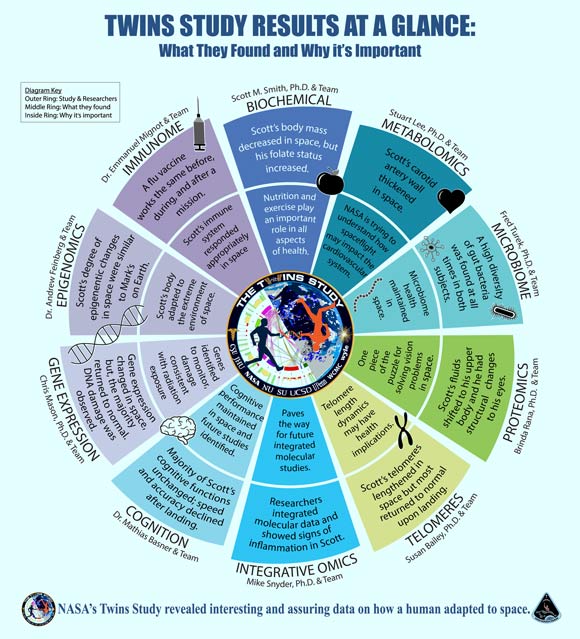
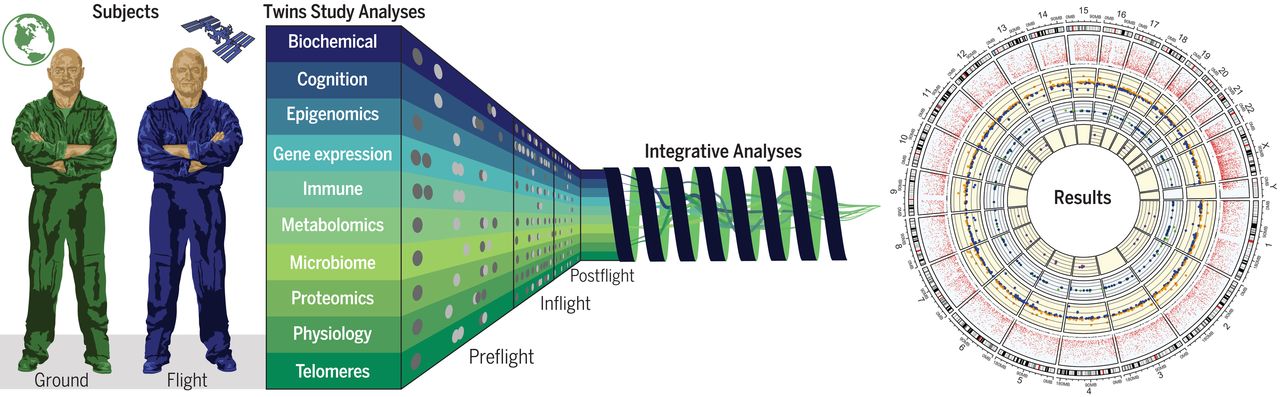
NASA’s Human Research Program took advantage of a unique opportunity to carry out the first genomic evaluation of the potential risks that the human body faces during extended periods of spaceflight. The results of the NASA’s Twins Study are not conclusive. The sample size consisted of one set of twins and not every variable was strictly controlled for. The study does provide researcher with a wealth of data to guide future studies on the risks of human spaceflight. NASA stated in a press release that “observations guide development of future hypotheses,” The NASA’s Twins Study has taken the first step in observing how our genomic blueprint is affected by long-term exposure to microgravity and an increased radiation environment. With the information collected as part of this set of studies, NASA has the preliminary data it needs to inform countless more projects for many years to come. The whole Twins Study will be summarized in a paper and each of the projects within the study will publish its own paper.
It is not too soon to begin to consider what countermeasures might be employed to mitigate the effects of space travel on the human body. The problem of microgravity can be countered by setting up a rotation system to mimic the Earth’s gravity. A ring-shaped craft could be used or a pair of chambers at either end of a tether. A ring or tether would have to be about two hundred meters in diameter or length respectively to counter Coriolis forces that would disturb balance. Greater insulating layers of dirt or water or a powerful magnetic field could be used to block space radiation on space stations. Special body suits could be developed to apply pressure to parts of the body to assist in the regulation of the movement of fluids. Electrical fields could be generated by such suits to counter the loss of bone content. We are entering an age of genetic manipulation with the CrisperCas9 technology. It may be necessary to develop new special processes in human bodies to prevent the damage and mutation of DNA and RNA in astronauts. Epigenetics may be modified to control expression of particular genes. Synthetic biology may be used to create new cellular machinery that could protect constituents and processes inside cells.
While many new tools and technologies may be needed to protect human health on long space missions, such developments will not necessarily be restricted to space missions. Technologies developed for space missions have proven to be useful for Earth-bound applications. Without a doubt, some of the health-related technologies developed for use in space will find worthwhile use on Earth. The NASA Twins Study was the beginning of an important field of study on how space travel will impact human health. The research started by the Twins Study will provide the foundation for a much greater understanding of human biology and its manipulation to deal with harsh environments in space or on other astronomical bodies. -

Biological Effects Of Space Travel – Part 4 of 5 Parts
Part 4 of 5 Parts
#8 – Living in space changes how genes are expressed
Andy Feinberg at Johns Hopkins University conducted a study that followed how each of the Kelly twins’ epigenetics differed based on their environment. Epigenetics is the study of how genes express themselves. In two separate populations of white blood cells, Feinberg found multiple regions of the genome where DNA methylation had occurred. Methylation is the process responsible for turning genes on and off. The chemical modifications found by the researchers to Scott’s genome were located near two interesting regions. One was close to a gene known to help regulate the growth of telomeres and another was found close to a gene related to collagen production. Although Scott did experience epigenetic changes while he was on the ISS, the researchers discovered that the majority of the changes were found within the expected range of variability for his twin on Earth. The results related to telomere growth and collagen production are consistent with the findings of other Twins Study projects.
#9 – Artery walls thicken while in space
Stuart Lee at KBRWyle in the NASA Johnson Space Center’s Cardiovascular and Vision Lab performed a study about inflammation and oxidative stress which is damage caused by free radicals in the air. It can impact the structure and effectiveness of arteries. In order to accomplish this, the researchers examined the twins’ arteries using ultrasound as well as collected blood and urine samples throughout the mission. During and immediately after the mission, the researchers found that Scott’s inflammation biomarkers were elevated and that the wall of his carotid artery was thicker than it was preflight. Neither of these changes were found in Mark during his stay on Earth. The researchers do not know whether the thickening of Scott’s carotid artery is a temporary and reversible adaptation to living in space or if it is evidence of permanent and premature arterial aging.
#10 – Proteins that regulate fluids increase while in space
Brinda Rana of the University of California conducted a study to collect urine samples from Scott and Mark before, during and after the mission. This allow Rana to identify certain biomarker proteins that are connected with space-related bodily changes, such as muscle and bone loss, metabolic and cardiovascular changes and the altered regulation of fluids within the body. The researchers discovered that while Scott was in space, he excreted proteins at different concentration than his brother Mark on Earth. Specifically, Scott had elevated levels of a protein called Aquaporin 2. This protein helps form the pathways used to carry water through cell membranes in the kidneys. Because aquaporin 2 assists in the regulation of how water is transported within the body, it also serves as an important indicator of a body’s overall hydration status. Significantly, the researchers found that Scott’s increase in aquaporin 2 during spaceflight was correlated with higher levels of plasma sodium. This is an indicator of dehydration. Though further study is needed, the researchers believe that the increase in aquaporin 2 and plasma sodium may be connected to fluids shifting throughout Scott’s body while he was in a microgravity environment. This is important because fluids tend to migrate to the head which causes visual impairment and intracranial pressure. These changes have been documented in studies of other astronauts.
Please read Part 5 next -
Biological Effects Of Space Travel – Part 3 of 5 Parts
Part 3 of 5 Parts
#6 – Space affects the microbiome
There is a vast community of microorganisms in the human gut. This is called the microbiome. It plays a very important role in our overall health. In order to study how living in a microgravity environment impacts the microbiome, Fred Turek of Northwestern University monitored the state of each of the Kelly twin’s microbiome before, during, and after Scott’s yearlong mission on the ISS. The research team found that the microbiomes of both Scott and Mark were drastically different at all times throughout the project. These differences were somewhat expected considering that microbiomes are very sensitive to environmental variances such as diet and individual immunity. However, the researchers state that Scott’s microbiome was different in space than it was in preflight. It displayed a decreased presence of one branch of bacteria called Bacteroidetes. These changes did not continue after Scott returned to Earth. While the study showed that Scott’s microbiome changed when switching between orbit and Earth, the changes were similar to those that would be expected if someone on the ground significantly changed their diet or was exposed to a new environment.
#7 – Spaceflight can trigger gene mutations
Chris Mason of Weill Cornell Medicine used the Twins study to investigate how space travel can influence genetics. His team used whole-genome sequencing to look for chemical changes in RNA and DNA. They were able to show that Scott experienced hundreds of unique gene mutation when compared to his twin. Some distinct gene mutations were expected but the sheer number of changes surprised the researchers. A few of these gene changes were discovered only after Scott returned from orbit. They were found on cell-free DNA and RNA that was circulating in his bloodstream. The researchers believe that these gene changes were caused by the stresses of space travel which can alter the biological pathways within cells, causing them to eject DNA and RNA. The free-floating DNA and RNA molecules can then trigger the production of new fats or proteins. They can even turn specific genes on or off. Ninety three percent of the genes that had altered expression while in space returned to normal postflight. The researchers found a subset several hundred “space genes” that remained disrupted after Scott’s return from orbit. Of the many gene-induced changes that Scott experienced, the researchers found five to be of particular relevance to future space missions. Scott experienced hypoxia which is a condition caused by a lack of oxygen and a surplus of carbon dioxide; Mitochondrial stress and increased levels of mitochondria in the blood; This suggests that there was damage to mitochondria; Telomeres lengthening, DNA damage and DNA repair increased while Scott was in space. This could be a result of living a healthy lifestyle while constantly exposed to radiation; Collagen production, blood clotting and bone formation all decreased. This was probably due to a combined result of living in microgravity and of fluids shifting around inside Scott’s body; and There was evidence of hyperactive immune activity which might be an effect of living in a new environment. This could also be a result of mutating bacteria.
Please read Part 4 next