Part 2 of 2 Parts
NASA has used aerobraking at Mars to alter the orbits of its scientific probes surveying the red planet. In 2014, the European Space Agency carried out a series of aerobraking maneuvers at Venus with its Venus Express spacecraft. Precise navigation is crucial for aerobraking. Coming in too high won’t produce enough air resistance to reduce velocity, while dipping too low could cause the spacecraft to reenter the atmosphere. The Space Force said it is using experience from civilian science missions to carry out the X-37B’s aerobraking maneuvers.
It appears that military officials have been planning this kind of maneuver with the X-37B for at least several years. In 2019, former Air Force Secretary Heather Wilson said that the spaceplane can fly in an orbit that “looks like an egg.” She was presumably referring to an elliptical orbit like the one the current mission is flying.
She added that “When it’s close to the Earth, it’s close enough to the atmosphere to turn where it is. Which means our adversaries don’t know—and that happens on the far side of the Earth from our adversaries—where it’s going to come up next. And we know that that drives them nuts. And I’m really glad about that.”
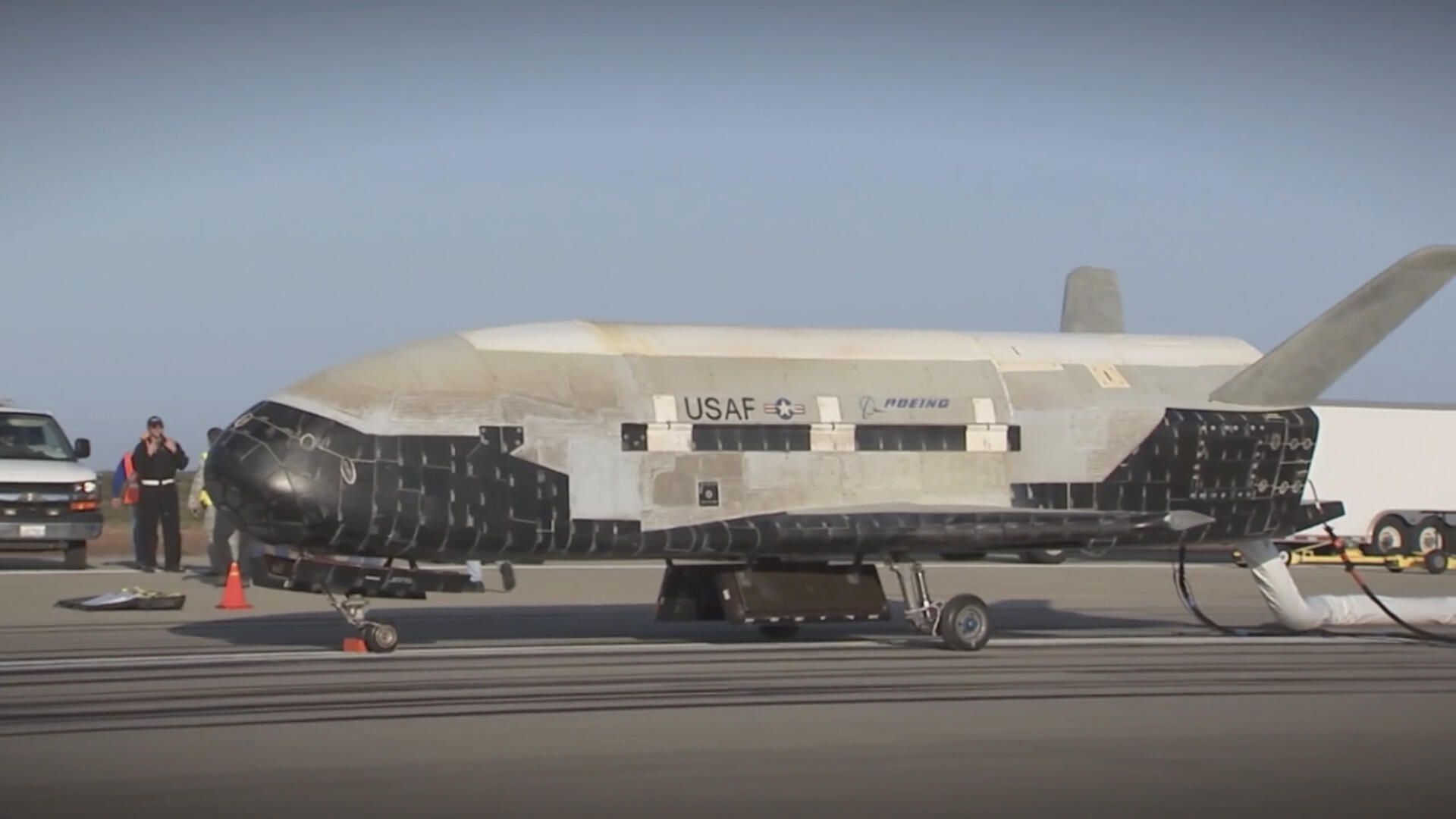
The Pentagon seldom releases an update on the X-37B spaceplane in the middle of a mission. During previous flights, military officials usually provided some basic information about the mission before its launch, then kept silent until the X-37B returned for landing. The military keeps specific details about the spaceplane’s activities in orbit a secret.
This made the Space Force’s announcement Thursday a surprise. When the seventh flight of the X-37B launched, there were indications that the spacecraft would reach a much higher orbit than it did on any of its prior six missions.
In February, a satellite tracking hobbyist spotted the X-37B in orbit by observing sunlight reflected off the spacecraft as it flew thousands of miles above the Earth. Additional detections confirmed the discovery, allowing amateur observers to estimate that the X-37B was flying in a highly elliptical orbit ranging between roughly three hundred miles and thirty-eight thousand and six hundred miles in altitude. The orbit was inclined fifty-nine degrees to the Earth’s equator.
On its previous missions, the X-37B stayed in low-Earth orbit a few hundred miles above the planet. When it became apparent that the latest mission was orbiting at a significantly higher altitude, analysts and space enthusiasts speculated on what the secret spaceplane was doing and how it would return to Earth. A direct reentry into the atmosphere from the spaceplane’s elliptical orbit would have exposed the craft’s heat shield to hotter temperatures than any of its previous landings.
With respect to what the X-37B is doing in orbit, the Space Force said the spaceplane on this mission has “conducted radiation effect experiments and has been testing space domain awareness technologies in a highly elliptical orbit.” The orbit brings the X-37B through the Van Allen radiation belts and crosses several orbits populated by U.S. and foreign communications, navigation, and surveillance satellites.
Military officials have said that previous X-37B flights have tested a Hall-effect ion thruster and other experimental space technologies without providing details. It has been reported that X-37Bs have also secretly deployed small military satellites in orbit.
Boeing X-37
Spacecraft – U.S. Space Force X-37B Finishes Seventh Mission – Part 2 of 2 Parts
Leave a Reply